Pre-Purchase Inspections — Buying a Home with a Pool or Spa: Separate the Building Questions
A house with a pool can look like the complete package. Before you buy, though, it helps to separate the condition of the home, the surrounding structures, the pool equipment and the pool barrier. A general building inspection should not leave you assuming that every pool-related question has been answered.
The next step is to agree the inspection scope early, ask for the available pool records and arrange any separate specialist checks before your purchase deadline. ClearScope can discuss the accessible building areas and visible concerns that belong in a pre-purchase inspection. Pool operation, barrier compliance and engineering questions need their own clearly identified assessment.
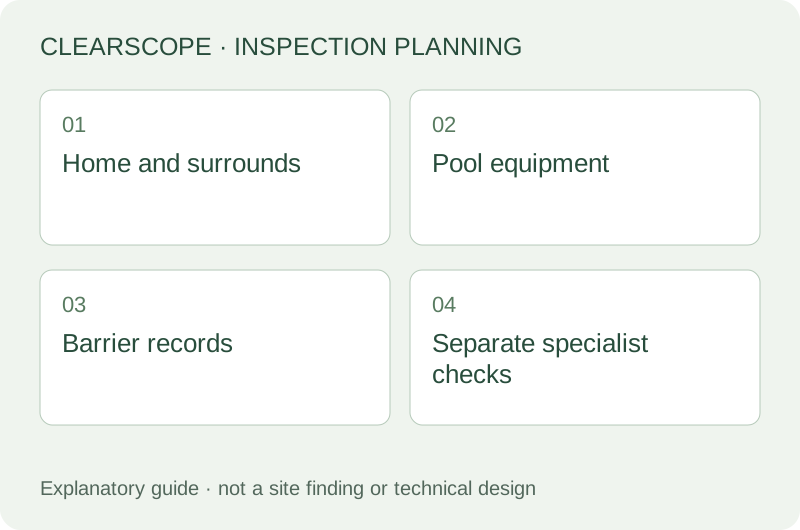
Begin with four separate questions
First, what is the condition of the home and its accessible external structures? Second, what can be established about the pool shell, plumbing and operating equipment? Third, what evidence exists about the safety barrier and its compliance? Fourth, do the pool, retaining walls and surrounding ground raise a structural or drainage question?
Those questions may involve different people. A pump running at an open inspection does not establish that buried pipes are sound. A tidy fence does not establish barrier compliance. A building report that records cracked paving does not certify the pool shell. Asking who will answer each question prevents gaps between appointments.
Before booking, send a short description of the pool, its relationship to the house and any particular concern. Tell us whether you are buying a detached home or a property with shared facilities. Common-property arrangements may require additional records and permission; our apartment inspection guide explains that distinction.
Ask for records before deciding what to inspect
Request available permits, pool registration information, barrier inspection documents and records of repairs. Ask whether equipment has been replaced, whether leaks have been investigated and whether the pool has recently been emptied, resurfaced or otherwise altered. A missing document is a reason to clarify the position, rather than a building diagnosis.
Victoria has a specific pool and spa registration and barrier inspection framework. Use the Building and Plumbing Commission pool guidance and confirm the current property-specific position with the relevant council. Do not assume a sale, an earlier certificate or a building inspection removes an owner's ongoing obligations.
Ask your conveyancer to review the transaction documents and advise what additional information is needed. ClearScope can discuss visible building condition, but does not determine ownership, easements, certificate validity or the seller's legal obligations. Keep the documents with the inspection reports so your advisers work from the same information.
Look at the pool's relationship to the house
A pool close to an external wall, garage, deck or retaining wall creates interfaces worth understanding. Observe where surface water can travel, whether paving slopes towards the home and whether there are accessible signs of moisture at adjoining walls. These observations can guide further enquiry without proving that the pool caused a problem.
A damp wall near a pool could have several sources. Splashing, garden irrigation, roof-water discharge, plumbing and ground drainage may all deserve consideration. A single inspection cannot recreate every weather or operating condition. The drainage guide for buyers explains how visible ground conditions differ from hidden drainage performance.
Tell the inspector about any known underground plant room, balance tank or inaccessible equipment enclosure. Restricted or unsafe spaces may remain outside the assessment. Do not enter them yourself to obtain photographs. An access limitation should be recorded and then considered against the question you need resolved before purchase.
Paving and retaining walls need their own context
Cracked paving, settlement at a coping edge or a gap beside a wall may be visible, but appearance alone does not establish the cause or suitable repair. Ask where the change occurs, whether there is displacement, whether the area drains and whether an earlier repair can be identified.
A specialist may need to assess a retaining wall or structural concern. The appropriate enquiry depends on the wall's role, construction, height, loading and relationship to other structures. A general building inspection is not an engineering assessment of the pool or its supporting ground. Read our retaining-wall buyer guide for the information to gather.
Also ask about access for maintenance and future repairs. A narrow passage may affect how contractors investigate or replace equipment. That is a practical ownership consideration, not proof of a defect. Seek a properly scoped quotation once the required work is understood, rather than assuming all pool repairs can be completed through the existing side gate.
Separate equipment operation from building condition
Pool pumps, filters, heaters, chlorination systems and controls need assessment by the appropriate pool specialist where their condition matters to your purchase. Confirm what is included: an operating demonstration, service assessment and leak investigation are different tasks. Ask what cannot be established without longer observation or further testing.
Do not assume ClearScope will pressure-test pool pipework, open electrical equipment, test water chemistry or assess every mechanical component as part of a standard pre-purchase inspection. Ask before booking if those are your priorities. A separate specialist report can be read alongside the building report, with each report's scope remaining clear.
Solar heating pipework or other equipment may also be installed on the roof. Roof access and electrical safety require separate consideration. The solar-panel buyer guide explains why visible roof observations do not replace assessment of the electrical or energy system.
A safety barrier assessment is a distinct service
Pool barriers need more than a quick visual impression. Gate operation, nearby climbable features, openings and changes around the barrier may all be relevant to a formal assessment. A general inspector noticing a concern does not turn that appointment into a statutory barrier inspection.
Confirm the qualifications and authorisations required for the assessment you commission. If a formal inspection or certificate is needed, arrange it with an appropriately authorised practitioner. ClearScope does not imply that barrier certification is included merely because the property has a pool. The booking agreement should state the actual service.
While viewing a property, do not prop gates open, move barrier components or leave children unsupervised near water. Ask the owner or agent to arrange safe access. If a barrier appears unsafe, bring the concern promptly to the responsible person rather than waiting for a routine report to be completed.
Build a decision list from the findings
Put each concern in a simple list: location, observed condition, unanswered question and the person best placed to answer it. For example, visible paving movement may need building or engineering follow-up, while unexplained water loss may need a pool specialist. A barrier document question belongs with the council, authorised practitioner or conveyancer as appropriate.
Ask whether proposed repairs address the cause or only the visible surface. Replacing a cracked tile does not establish why it cracked. A service receipt for a pump does not establish the condition of the entire installation. Keep quotations specific enough that you understand the assumptions and exclusions.
For general purchase preparation, Consumer Affairs Victoria encourages independent inspection before committing. Your purchase timing matters: ask your conveyancer about the actual deadline and access rights, rather than assuming you can investigate after the auction.
Questions to resolve before booking
Does the proposed building inspection include the accessible pool surrounds and associated external structures? Which pool elements are expressly excluded? Is a separate pool technician or barrier practitioner needed? Who can provide access and the available records? These are useful questions even when the pool looks well maintained.
If the property has a spa instead, ask the same scope questions. Above-ground, portable and built-in arrangements can have different documentation and practical access issues. Do not infer an exemption or a particular regulatory outcome from appearance; confirm the applicable requirements with the council and your advisers.
If records are unavailable, identify the unresolved question clearly. You can still obtain useful observations, but missing evidence should not be converted into a promise that the installation is compliant or trouble-free. The value of inspection is understanding what is known and which important decisions still need information.
Keep specialist reports connected
Ask each provider to identify the areas and equipment assessed, the inspection date and the important exclusions. If a pool specialist raises a concern about supporting ground or a nearby wall, refer it to the appropriate building or engineering professional rather than assuming it falls within the equipment service. Likewise, send building observations relevant to the pool back to the specialist. Coordinating the reports does not merge their scopes. It helps you see which questions have an answer and which still depend on another assessment. Keep that list with your purchase documents so an unresolved item is not lost between separate appointments.
Arrange the right combination of checks
Send ClearScope the address, purchase deadline, property type and any concerns about the building or pool surrounds. Include available photographs and tell us whether pool equipment or barrier certification is a priority so we can explain the scope boundary before you book.
You can view report examples to understand the reporting style and discuss your property with ClearScope. The aim is a coordinated set of answers: useful building observations, appropriate specialist checks and a purchase decision made with fewer important unknowns.