Pre-Purchase Inspections — Buying a Townhouse with a Shared Driveway
Buying a townhouse where several homes use one driveway? Identify the visible condition, the areas the inspector can access and the records you need before budgeting for future work.
Explore pre-purchase inspection options
Map the route before the inspection
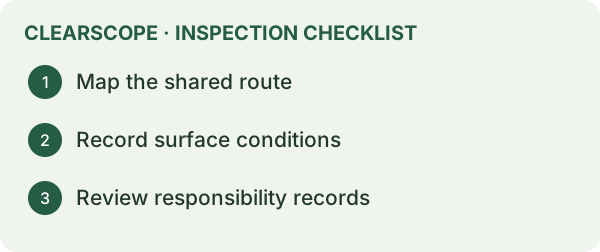
Mark the entry, bends, garage approach and pedestrian route on the listing plan. Ask the agent what areas can be accessed and whether gates or vehicles will block the route. If you expect to use the space for turning, ask to see how the route works with other vehicles parked. Keep suitability for your vehicle separate from the inspection of visible building conditions.
Observe where water and movement may matter
Tell the inspector about pooling, a raised slab joint, a damaged grate or cracking near a garage entrance. A location-specific observation helps identify where further assessment might be needed. A photograph of a drain grate establishes what is visible at that point. It does not establish the state or ownership of underground drainage.
Check documents with your conveyancer
Request the plan of subdivision and relevant owners corporation records where applicable. Ask about areas of common property, arrangements for maintenance, planned works and any restrictions that matter to your use. The visible route can cross boundaries that cannot be identified accurately from paving changes or fencing alone. The report can help you frame questions for the people reviewing the documents.
Use a concrete example to follow up
If several slabs are visibly displaced near your garage, ask which area was inspected, whether other sections could be observed and whether the building report recommends further assessment. Then ask who has responsibility for that area and whether repairs have been discussed or funded. The answers can come from different sources, so keep the report and the written records together.
An inspection-day example
Consider a townhouse at the rear of a site where water marks are visible at the garage edge and the shared driveway has been patched above a drain. Ask the inspector to record both observations by location. Ask the agent whether the repair history and drainage maintenance records are available. The marks and patch are useful evidence, even if the connection between them is unresolved.
Translate findings into questions about planned works
If the report notes cracked paving, ask your conveyancer what records describe repair proposals, funding or prior maintenance. Where access was partial, avoid treating the report as a survey of all common areas. Discuss whether a separate review would be useful before your deadline.
Allow time to make sense of the documents
Share the decision date when you book. If your contract review and inspection happen at the same time, keep a simple list of matters each adviser is checking. A practical division is visible conditions with the inspector, records and obligations with the conveyancer, and access with the agent.
Share the concerns before booking
Send the address, the agent contact, access information, any relevant plan and your decision deadline. Ask ClearScope to confirm the property and driveway areas covered by the proposed inspection, and list any common areas you want discussed separately.
Walk the path a vehicle and a pedestrian actually use
Start at the street and work towards the garage or parking space included in your purchase. Mark where the route narrows, bends or changes level. A level area at the front may lead to a steep transition near the car space. At a bend, look for an upstand, drain grate or patch where a wheel passes close to an edge. Identify where people on foot step away from the vehicle path. These observations help you decide whether to ask for more information about a particular defect, arrange a permitted second visit or discuss how you intend to use the property.
Surface materials can change along the route. Concrete might stop at a control joint and continue in pavers beside a garage, or an asphalt section may be patched near a drain. Record the location of each change before discussing damage. A straight joint between slabs has a different appearance and role from a jagged crack crossing a slab. If one side of a joint appears higher, show which surface is raised and where people walk across it. A wide photograph helps a person reading the report find the spot, while a closer image can show the visible condition. Keep the image labels tied to a gate, bay or plan position.
A buyer planning to park a larger vehicle has a separate question about manoeuvring. Ask the agent for permission if you want to check how an ordinary vehicle of the relevant size uses the approach. Observe where the grade changes relative to the vehicle and whether a tight turn would bring tyres close to an edge. Tell the inspector if you noticed scraping or damage at a particular location. A visual building inspection can describe the surface and relevant features, while suitability for a particular vehicle or proposed work may need a separate assessment. The outcome can matter even where the rest of the driveway appears serviceable.
Track water from the high point to the nearest visible outlet
A shared driveway can receive runoff from more than one lot. Look beyond the wet patch to the uphill surfaces that lead toward it. Follow the visible falls, kerbs, channels or wall edges from a place you have permission to access. Notice whether there is a drain near the garage threshold or whether water appears to run beyond it towards another unit. If the pavement is dry, tell the inspector where water was seen at a previous visit and what the weather was doing. A record from a rainfall event and a report from a dry visit can be useful together.
Ask the inspector to distinguish surface drainage from the parts they could not see. A grated opening is observable, while its pipework and discharge are generally concealed. A heavily marked wall beside the drive could have been affected by splash, water held against it or a separate source. If the wall belongs to the property under offer, ask for the corresponding interior area to be considered where accessible. If it is outside the agreed inspection scope or on adjoining property, record the limit. Where the runoff question could affect your purchase or planned work, get advice from an appropriate drainage practitioner and provide the site layout.
In an example, a buyer sees water pooled by the last garage after rain. There is also a worn strip along a change of paving near the middle of the drive. The two observations may be related or may need different follow-up. A drainage practitioner can use the report and site sketch to identify what levels or connections need further investigation. A building contractor assessing the worn strip can use the same location reference to estimate a local repair. Ask each person to identify any approvals, access or unresolved site conditions they are assuming before you rely on a quote.
Use the lot plan and records alongside the physical findings
Mark the observation on the plan you have and give both the report and image to your conveyancer. Ask them to help identify whether the relevant land is common property, part of a private lot or subject to an access arrangement. The edge of a concrete pour or the position of a gate may be a poor guide to a title boundary. Consumer Affairs Victoria's guidance on owners corporation maintenance surveys explains how inspections and maintenance plans can inform management of common property. A driveway observation is a prompt to check which arrangements apply to the actual property.
Look for records that refer to the same location. If minutes mention a drainage quote, ask which inlet or pipe it covers, whether work has been authorised and whether the invoice or completion record can be obtained. A past quote may describe a different section of the driveway. Ask your conveyancer how to follow up records that affect your purchase and whether other relevant documents can be requested. If the owners corporation has no information about the location, record that as an unanswered question. It is still useful to know that the condition report and the documents cannot yet be matched.
Suppose the inspector observes a raised joint across part of the access route, and meeting minutes refer to resurfacing near the front of the complex. Establish whether the discussion relates to the raised joint before assuming a repair is planned. If work has been approved, ask whether access to your garage will be affected and who can confirm the timing. If you intend to install a gate or change paving next to the route, raise that separately. A routine repair and a proposed alteration can involve different people and decisions.
Make the driveway one part of your purchase brief
Send the inspector the lot address, the location of the parking space and a brief description of how you reach it. Mention any drainage concern, raised edge, reversing constraint or pavement movement you noticed. If the visit will be limited to the lot and specified accessible areas, agree that scope up front. Ask the agent who can provide access to common or gated areas and record any part of the route that cannot be viewed. Our Melbourne pre-purchase inspection page explains how to prepare the wider property brief.
When you receive the report, group findings into a safety issue to clarify, repairs to price, and items that need documents or further access. Rank them according to your likely use of the property. A buyer who expects deliveries to the rear may need answers about a tight corner sooner than a buyer who only parks at the front. A parent who uses the driveway on foot each day may give a raised joint a different priority. The inspection gives the condition observations, and you can apply them to the way you will actually use the property.
Keep each open question tied to a person who can answer it and the time available. The inspector can explain what was visible and where the evidence ends. The conveyancer can deal with property documents and purchase terms. The relevant trade or specialist can investigate a drainage or pavement question where appropriate. If access for follow-up will be limited, provide that information before booking anyone to return. This gives you a practical way to make decisions about a driveway that serves several homes and may involve several owners.
Check that the records cover the whole route
If the lot has more than one way in, distinguish the ordinary entry from any secondary lane, visitor spaces or emergency access. A report that considers the main driveway may say little about an alternative access you expect to use. Ask the agent to identify which gates can be opened and where visitors are expected to park. If an alternative route is important because the main approach is steep or narrow, raise that explicitly before the inspection.
After the visit, put the report photo, title plan and maintenance record beside each other for any location you intend to follow up. Make a simple note if those documents point to different locations or are too vague to match. The same address may appear on all three records even though each covers a different area. Where the difference matters, ask for a marked plan or a more specific record rather than treating the documents as interchangeable. That can prevent a repair allowance being assigned to the wrong part of the development.
Talk to ClearScope about the inspection
Tell us the address, the date that matters and the item you want checked so we can discuss scope and availability.