Roadworks, Excavation and Civil Works Near Your Property: When a Dilapidation Report Can Help
A letter arrives about road reconstruction, a drainage upgrade or excavation near your property. You may wonder whether the work could affect your driveway, front fence or house, and whether you should record their condition before the project begins.
A dilapidation report can provide a dated record of agreed accessible areas. It helps replace uncertain recollection with descriptions and photographs. It does not predict damage, determine safe vibration levels or prove that nearby works caused a later crack.
Civil projects also have their own arrangements for access, condition surveys, monitoring and complaints. Start by finding out what the project is offering and what your property-specific concerns are. That will help you decide whether an additional independent record would be useful.
Find out what work is actually planned
“Roadworks” can cover resurfacing, drainage trenches, service relocation, retaining structures and deeper excavation. Those activities do not create identical questions for neighbouring properties. Obtain the project notice and ask for the work stages near your address.
Useful information includes the location, expected dates, access changes and project contact. If the scope is still evolving, keep the latest written update. A general completion date for a large project may not identify when work will reach your frontage.
Do not assume that all equipment visible in the street will operate beside your house or that a particular machine will necessarily cause damage. The condition-report brief should be based on the known activity and your actual property rather than speculation about the whole project.
Ask about the project’s condition-survey programme
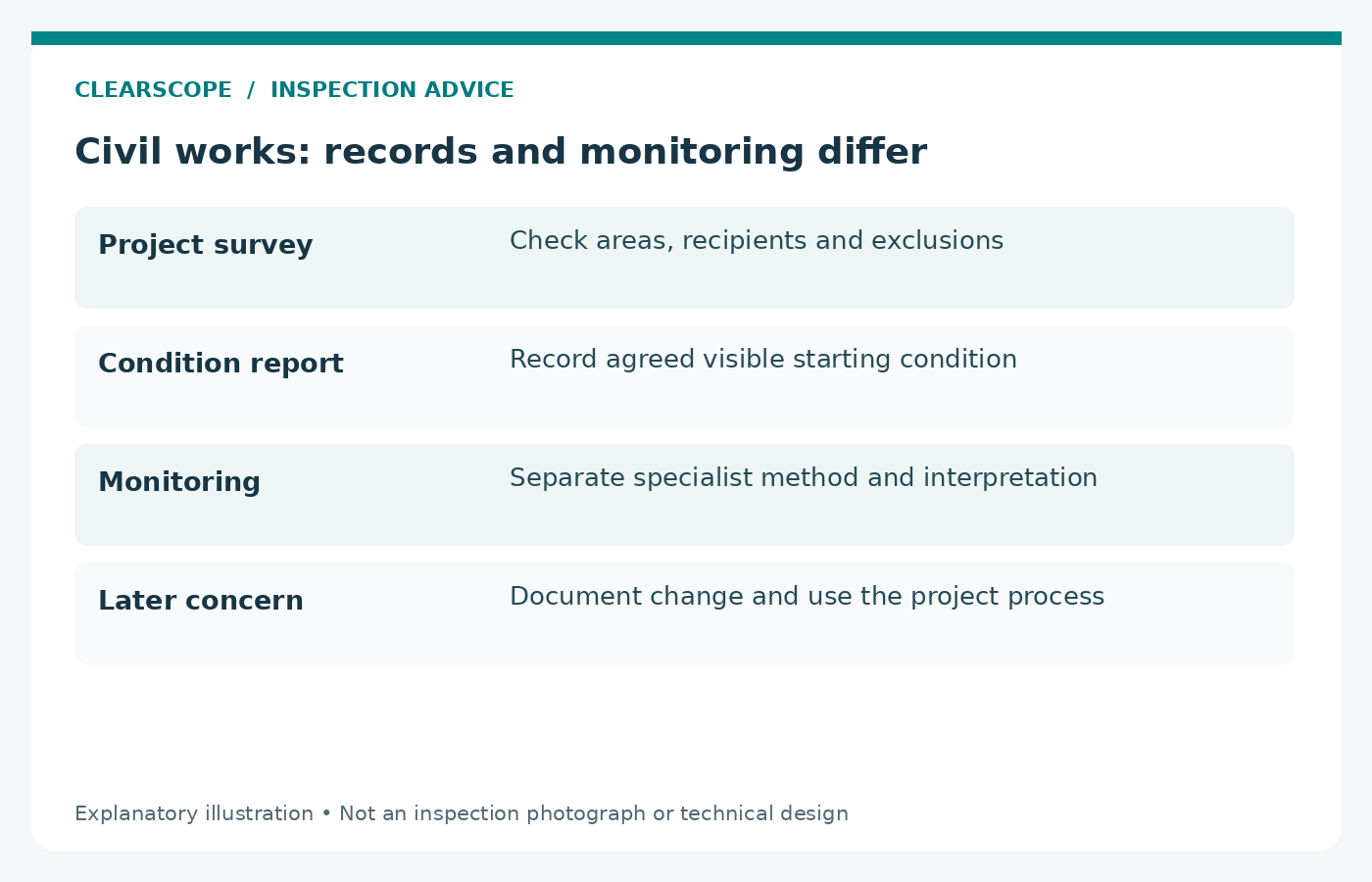
The contractor or project authority may offer a pre-works survey. Ask which properties and areas are included, who is conducting it, who receives the report and how to request corrections or report an omission.
Read the scope before assuming the offered survey covers the inside of your home, rear structures or an important retaining wall. A frontage-only record may be useful for the road interface while leaving other areas outside its purpose.
Our guide to checking a supplied dilapidation report explains the document questions. A report arranged by a project is not automatically unsuitable, and an independent report is not automatically more comprehensive. Compare the actual coverage and terms.
Identify the property areas you want documented
Consider the house, accessible rooms, driveway, crossover, paths, fences, garden walls and retaining structures. Include garages or outbuildings where relevant. Prioritise the areas connected to your concerns instead of assuming everything will be documented in equal detail.
A frontage inspection might record existing paving cracks, damaged edges and fence alignment. An internal condition schedule may identify wall and ceiling cracks in agreed rooms. The report should make the distinction clear.
The dilapidation inspection service can be scoped around those needs. If ownership or responsibility for a crossover, verge or retaining wall is unclear, seek advice from the relevant authority or adviser. A condition report does not resolve the ownership question.
Record existing defects without guessing their cause
A baseline should identify visible condition even when the cause is unknown. Existing cracks, previous repairs, staining and deterioration can be described with their locations and relevant photographs. The report should not need a speculative explanation for each mark.
An old patch may make earlier cracking impossible to assess. A hedge may obscure a fence, and a vehicle may cover part of a driveway. Record these limitations rather than describing an area as defect-free because nothing was visible from the available position.
If there is already a significant concern, arrange the relevant assessment separately. The new recurring-crack investigation guide explains one example. Recording a crack for comparison is different from determining whether a structure is safe.
Separate your house from the public works area
The project may involve a footpath, road reserve or utility corridor outside your title. Ask the project authority about access restrictions and how the work interfaces with your property. Do not enter a worksite to collect condition evidence.
Photographs taken lawfully from safe accessible areas can be useful, but they should not be presented as an engineering inspection of the excavation or works. The contractor and relevant professionals remain responsible for their own planning and assessments.
The WorkSafe excavation compliance code provides safety context for excavation work. It does not give a homeowner a site-specific safe distance, design or permission to inspect construction activities.
Understand the difference between condition records and monitoring
A condition report is a snapshot. Vibration monitoring, movement monitoring and technical assessment of excavation effects are separate services with their own methods and interpretation. They should not be implied by the word dilapidation.
If monitoring is offered, ask who specifies the locations, what is measured, who receives alerts and how results will be interpreted. A device on one wall does not automatically represent every structure on the property.
Do not use a generic vibration number found online to decide whether the project is safe or a crack was caused by the work. The relevant specialist needs to consider the structure, activity, measurement and applicable criteria. ClearScope’s ordinary condition-record scope does not include that engineering determination.
Arrange access before the relevant activity begins
Contact the inspection provider while there is time to agree scope and access. If the work programme is uncertain, identify the earliest relevant activity rather than relying only on the overall project start date.
Occupied properties, tenancies and owners corporation areas may need several permissions. Ask who can authorise entry and arrange keys. Our multiple-property coordination guide is useful where several dwellings are involved, although the civil project’s survey arrangements may differ.
If work has already started, disclose the date and activity. A report can still record current condition, but it should not claim to establish a baseline for work completed before the visit. Accurate evidence is more useful than an inaccurate before-works label.
Keep a simple personal record alongside the report
Retain project letters, report versions, relevant emails and dated photographs in one place. If you take photographs, include an overall view to identify the location as well as a closer image of the feature. Preserve the original files where practical.
Keep notes factual: the date you noticed a change, where it appeared and what you observed. Avoid recording an assumed cause as though it had already been established. “New mark noticed on bedroom ceiling” is different from “excavator caused roof leak”.
A personal record supplements the professional report; it does not turn an unmeasured image into a structural assessment. If a concern affects safety or active water entry, arrange the appropriate response promptly and preserve evidence where safe to do so.
Report a concern through the project’s process
Use the named project contact and describe the issue clearly. Ask how the concern will be inspected, what information is needed and how to retain a reference number. Keep copies of the response and any proposed action.
If someone attends, note their role and what they assessed. A site visit, an undertaking to review photographs and an issued technical report are different stages. Ask for the actual written outcome where the issue remains important.
A dilapidation comparison inspection may help document differences from the baseline. It cannot substitute for the project’s engineering response or determine legal responsibility. If the matter is disputed, obtain the relevant independent technical and legal advice.
Distinguish civil works from building protection work
Do not assume that every road or utility project follows the same process as private building work next door. Ask the project authority what approvals, survey arrangements and complaints process apply to the actual activity.
Victorian building protection work is a specific process explained by the BPC adjoining-property guidance. Its application should be confirmed by the relevant practitioners, rather than inferred simply because excavation is involved.
Our neighbouring demolition and excavation guide addresses private nearby building works. This article focuses on project notices, frontage interfaces, condition-survey offers and the distinction between records and monitoring for civil works.
Compare inspection quotes by scope
Tell each provider about the same structures, access and intended use of the report. Ask whether written observations, identified photographs and agreed internal areas are included. Clarify report delivery timing and any separate comparison visit.
Our dilapidation cost guide explains why price alone can be misleading. One quotation may cover a driveway and fence while another includes the dwelling interior and several outbuildings. Neither should be described as equivalent without checking the scope.
Also ask about limitations. A condition record does not normally include testing underground drains, surveying boundaries, environmental sampling or certifying structural capacity. If one of those questions matters to you, raise it explicitly so the appropriate specialist can be identified.
A practical example
Suppose a drainage trench is planned along the street and the project offers an external survey. Your main concern is an existing crack beside a front bedroom window and older cracking through the driveway.
Ask whether the project survey includes those areas and whether you will receive the record. If the bedroom is outside the offered scope, an additional agreed inspection may fill that particular gap. Keep the two reports clearly identified rather than treating either as an exhaustive record.
If a change is noticed later, the baseline can assist comparison at those locations. The cause still needs assessment alongside the project records, property history and any other relevant evidence. The chronology is useful, but it does not settle the conclusion on its own.
Common questions
Do roadworks automatically mean I need a private report?
No. Review the proposed works, existing survey offer and the areas important to you. A separate report is a scope decision, not evidence that damage is expected.
Does a report include vibration monitoring?
Only if expressly commissioned through an appropriate service. An ordinary dilapidation inspection should not be described as monitoring or a prediction of construction effects.
What if the report is arranged after work begins?
It records condition at that later time, with the timing disclosed. It cannot recreate an unrecorded earlier condition.
Discuss the record you need
Send ClearScope the project notice, property address, proposed dates and areas of concern. We can discuss an appropriate dilapidation report scope and explain which questions require separate specialist advice.
Ask ClearScope about condition records before nearby civil works.