Special-Purpose Building Reports — Cracks That Reappear After Repairs: What to Investigate Next
The crack was filled and painted, but the line has returned. Perhaps it is in the same place, perhaps it has spread, or perhaps a different wall is now affected. Before another cosmetic repair, it helps to understand what was repaired and what evidence is available about the recurrence.
A returning crack does not automatically establish foundation failure. It also should not automatically be dismissed as ordinary settlement. The material, location, repair method, timing and associated changes all matter.
A special-purpose building report can be scoped around those questions. It may document accessible condition and recommend further assessment, but it is not automatically an engineering investigation, movement-monitoring programme or designed repair. Agree the task before assuming what one visit will resolve.
Confirm whether it is the same crack
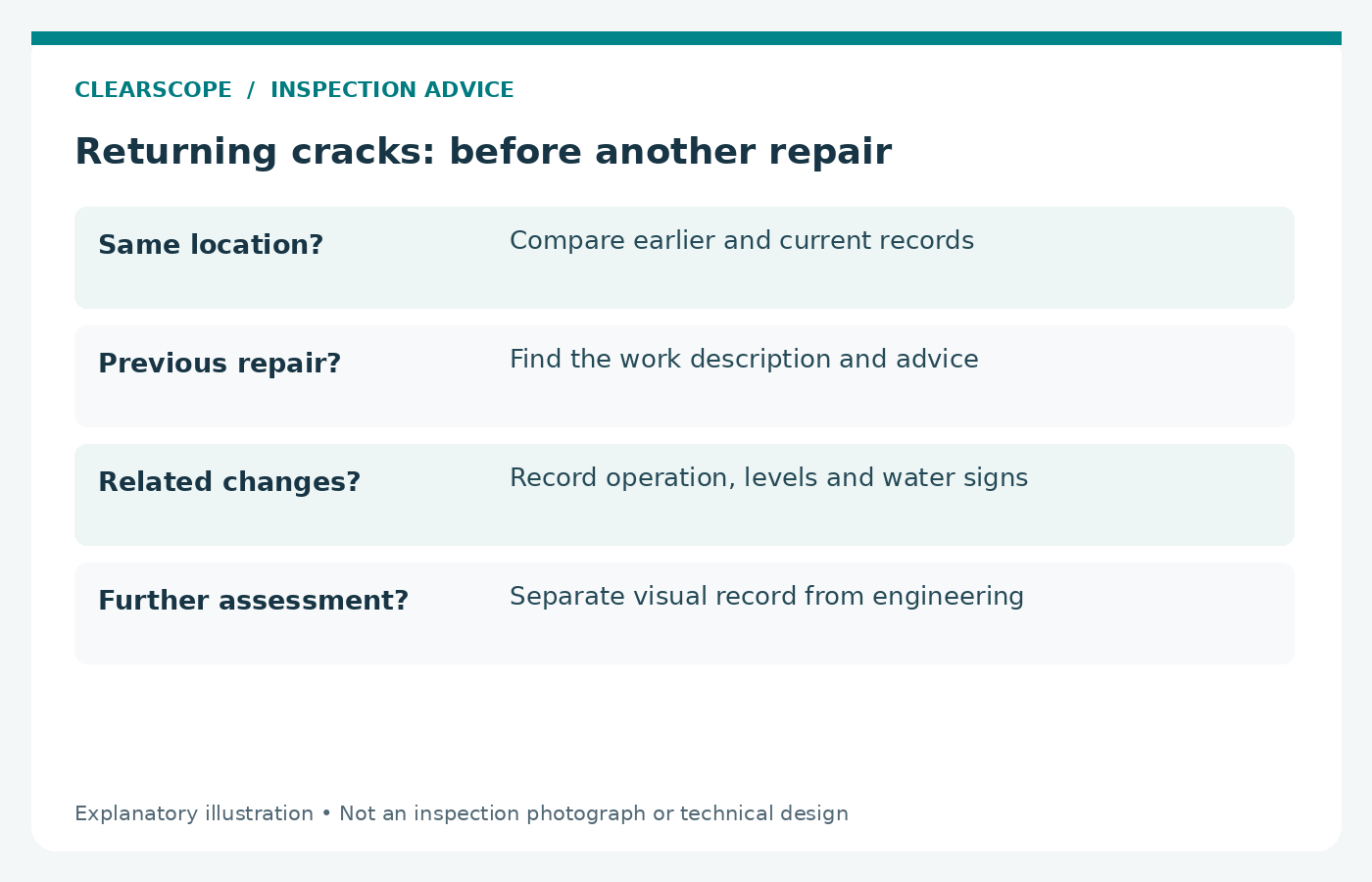
Compare the current location with earlier photographs and repair records. Use room names, wall directions and nearby openings to identify the feature. A line beside a window may be difficult to distinguish from another nearby repair once the wall has been repainted.
Describe what has changed without assuming the explanation. Has a filled line become visible again, has the surrounding material separated, or is there a new crack outside the repaired area? The distinctions may help the investigator understand the repair and current condition.
If there is no earlier image, say so. A memory that a crack “was about the same” can be useful background, but should not be presented as a measured comparison. Keep the uncertainty visible rather than reconstructing an exact history that does not exist.
Identify the material and junction
Cracks through plasterboard, masonry, render, concrete, grout and sealant can have different implications. A crack at a material junction is not necessarily the same problem as one through the body of a structural element.
Tell the provider which surface is affected and whether the line appears on the other side of the wall or in adjoining finishes. A visual visit may identify the exposed material, while concealed construction remains uncertain.
Our brickwork cracking guide focuses on masonry in new homes, and the hairline crack guide covers fine plaster observations. This article focuses on recurrence and repair history. It should not be used to apply one explanation across every type of crack.
Find out what the previous repair actually did
A repair may have filled a surface, replaced a lining, reinstated a movement joint or addressed a supporting element. Those are different scopes. Request the contractor’s description, date, photographs and any advice that led to the work.
“Crack repaired” does not establish that an underlying mechanism was identified or that a structural repair was intended. A decorative repair can be appropriate in some circumstances, but it should not be described as resolving a cause that was never assessed.
If an engineer previously provided advice, obtain the report and ask whether its recommendations were carried out. Compare the actual work with the recommendation rather than assume an invoice proves every item was completed. A new assessment may be needed if the condition has changed.
Build a simple timeline
Record when the crack was first noticed, when it was repaired and when it returned. Include relevant changes such as renovation, plumbing leaks, drainage work, nearby excavation or altered landscaping, without deciding that timing proves causation.
The timeline can help identify questions for investigation. For example, a crack that returned immediately after repainting may raise different repair-detail questions from one noticed after several years. Neither timing alone establishes the technical answer.
Keep weather and occupancy observations proportionate. You do not need to become a building researcher to seek help. A few dated factual notes and original photographs are usually more useful than a long account that mixes observation with unverified explanations.
Look for associated changes
Doors that have started binding, uneven floors, displaced masonry, water entry or visible distortion may change the significance of a crack. Report those observations to the provider before attendance so the scope can be discussed.
The new uneven-floor guide explains one related enquiry, although its main audience is buyers. The older-brick movement guide discusses broader patterns. A crack should be considered in the context of the actual building rather than judged only from a close-up image.
If a wall appears unstable, material is falling or there is a sudden significant change affecting safety, restrict access and obtain prompt appropriate assistance. Do not wait for a routine report or push on the structure to see whether it moves.
Consider whether movement provision was altered
Some repairs can bridge a junction intended to accommodate movement. Rigid filling, render or finishes across such a detail may be relevant, but the intended construction needs to be established before a conclusion is made.
Our bridged articulation-joint guide and new pre-scaffold-removal joint guide explain the masonry context. A recurring line does not itself prove a missing or defective joint. Drawings, product details and accessible construction may be needed.
Do not cut new joints or remove sealant based on a general article. Changing movement details can affect performance and surrounding work. The relevant designer or practitioner should determine the appropriate repair where the design is uncertain.
Distinguish recording from diagnosing
A focused visual inspection can describe the crack, its location, visible associated conditions and the limitations affecting assessment. It can also identify questions that need further professional input. That is useful work even where the ultimate cause cannot be confirmed immediately.
An engineering assessment may be required to address structural adequacy, mechanisms of movement or a designed repair. A geotechnical, plumbing or drainage investigation may also be relevant in particular circumstances. The need depends on the observations and history.
BPC guidance on freestanding walls illustrates why cracking and leaning in those structures deserve attention. It is specific safety guidance, not a diagnostic rule for every internal wall or a universal crack-width threshold.
Agree whether measurements will answer the question
A photograph with an appropriate reference can help describe a visible crack. More formal measurements may be useful where a qualified professional considers them relevant. Ask what will be measured, by whom and how the information will be interpreted.
A single measurement does not show whether movement is ongoing. Monitoring requires a planned method, repeat observations and an agreed response to change. It should not be implied by one inspection or a strip of tape placed across a crack.
If monitoring is recommended, clarify the purpose and timeframe. For a buyer or an owner about to renovate, waiting may have practical consequences. Discuss those consequences with the relevant adviser rather than treating a monitoring suggestion as a complete answer to an immediate decision.
Keep water and ground conditions as questions, not assumptions
Drainage problems, plumbing leaks and changed moisture conditions can be relevant to some movement investigations. Their presence does not prove that they caused a particular crack. Equally, the absence of visible water on a dry day does not rule out intermittent issues.
The drainage guide and underfloor moisture guide explain accessible observations. Where concealed pipes or ground conditions need assessment, arrange the appropriate specialist rather than assume an ordinary visual inspection includes those tests.
Avoid making major landscaping or drainage changes solely from a guessed cause. A repair strategy should address the actual evidence and the whole building context. The wrong intervention can complicate both the condition and the later investigation.
Prepare a brief that leads to a useful report
State the question you need answered: whether the repair has failed, whether the current condition warrants engineering or what further evidence is needed before another repair. Include the address, building age if known, affected locations and repair records.
Tell ClearScope who will receive the report and how you intend to use it. A maintenance enquiry, a buyer’s concern and a disputed rectification matter may need different scope and professional input. The report format should suit the agreed purpose.
Use the service overview and contact pathway for a special-purpose enquiry. Where relevant, the report is prepared and authorised by a suitably qualified ClearScope Building Practitioner. This wording does not imply every enquiry includes specialist engineering or litigation services.
Plan the next repair and its review
Once the relevant assessment is available, ask the contractor to describe the proposed work and its basis. Clarify what will be removed, what will be exposed, how the repair addresses the identified issue and what remains uncertain.
A rectification reinspection can be scoped to relevant visible work before it is covered. Arrange the timing early enough to see the important stage. A final painted surface may establish presentation while leaving the underlying repair concealed.
Keep records of the completed work and any recommended follow-up. If the crack returns again, the next investigator should be able to understand the sequence without reconstructing several years of conversations. Preserve earlier versions rather than replace them with a single undated photo folder.
Keep responsibility separate from the technical finding
A returning crack may be relevant to a builder, insurer, previous contractor or another party. The technical report does not automatically decide liability, warranty entitlement or payment. Those questions depend on the circumstances and relevant documents.
Our guide to a builder’s response helps organise factual questions and item-specific evidence. Raise the issue in writing and retain the response. If legal advice is needed, obtain it separately rather than ask the inspector to determine contractual rights through a visual observation.
Common questions
Does recurrence prove the original repair was wrong?
No. It establishes that the line or condition has returned. The original scope, current findings and any changed circumstances need review before deciding why.
Can a crack be assessed from one photograph?
A photograph can help identify the concern and plan a visit. It rarely supplies the whole building context, repair history or concealed information needed for a reliable diagnosis.
Should I fill it again before the inspection?
Where safe, preserve the visible condition until the scope is agreed. If urgent work is necessary, document the condition and actions taken. Do not delay a safety response simply to retain evidence.
Will a report guarantee that the crack never returns?
No. The report should explain findings, limitations and recommended next steps. A future-performance guarantee is different from an agreed building assessment.
Discuss the recurrence before another cosmetic repair
Send ClearScope the affected locations, earlier photographs, repair dates and any previous professional advice. We can discuss a focused scope and identify when engineering or another separate investigation may be needed.
Ask ClearScope about cracks that keep returning.