Pre-Purchase Inspections — Cracked Shower Tiles, Failed Seals and Hidden Moisture
Cracked tiles or worn seals in a bathroom can look like a small maintenance job. When you are buying the home, the important question is whether the visible finish is the whole issue or whether moisture has affected areas you cannot see. A visual check cannot answer that by appearance alone.
Start by recording the location and the surrounding evidence. A pre-purchase inspection can document accessible condition and help identify the next investigation. It does not expose the membrane beneath tiles or guarantee that a shower is watertight. Tell ClearScope about the bathroom concern and your purchase deadline before booking.
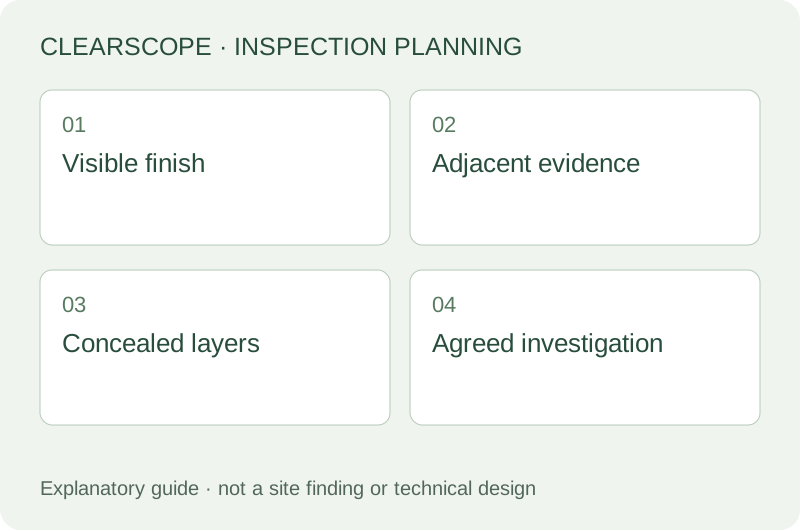
Separate the visible layers
Tiles and grout form the visible finish. Flexible seals accommodate particular junctions. The concealed waterproofing system serves a separate purpose. A crack in one layer can raise a question about the wider arrangement without proving that every layer has failed.
Likewise, a bathroom can look tidy while concealed defects remain. New grout or silicone may improve a surface but cannot, on its own, demonstrate the condition of an underlying membrane. Ask what was repaired, why it was repaired and whether the work involved only the visible finish.
Our tile and grout cracking guide explains the finish question in more detail. This buyer guide focuses on the decision before purchase: what can be observed, what records help and when a separate investigation should be considered.
Record the crack in context
Identify whether the crack is in a tile, a grout joint or a change of plane such as the wall-to-floor junction. Note whether tiles appear displaced, whether the same pattern continues outside the shower and whether an earlier repair is visible. Avoid reducing the assessment to a single crack-width rule.
The substrate, installation, movement and service history can all affect interpretation. A photograph may locate a concern but cannot establish the condition behind the tile. An inspector should describe the evidence and explain any recommendation for further assessment, rather than diagnose concealed failure from one image.
If you have photographs from earlier viewings, retain their dates and locations. A visible difference can be useful, but changes in lighting or camera angle can alter appearance. Do not describe a crack as growing unless the comparison is sufficiently clear to support that statement.
Look beyond the shower enclosure
Moisture-related evidence may appear at adjacent skirting, the back of a wall, a doorway or the ceiling below an upstairs bathroom. Swollen joinery, damaged paint or local staining can help identify where further enquiry is needed. None of those observations automatically identifies the source.
A nearby pipe leak, splash water escaping the screen or a drainage issue can present differently from concealed membrane failure. More than one issue may exist. Our shower-screen leak guide separates screen containment from waterproofing so a repair can address the actual mechanism.
Check whether adjoining rooms and the level below will be available during the inspection. Furniture, cabinetry, stored items or locked rooms can limit visibility. Where access is not available, the report should record that limitation; a clear bathroom wall is not proof that all adjoining materials are unaffected.
Ask about use and recent repairs
Find out whether the shower has been used regularly, was recently taken out of service or has been dry while the property was vacant. That history may help interpret the conditions at inspection, but it should be identified as supplied information rather than a verified fact.
Request available invoices, repair scopes, renovation documents and photographs. Was the shower regrouted, resealed, rebuilt or investigated for a leak? Those descriptions cover very different work. Ask the contractor's name and the date, but do not assume that an invoice or warranty demonstrates every concealed detail is satisfactory.
If the bathroom was renovated by an owner-builder, tell your conveyancer. Documentation and sale obligations need property-specific advice. The owner-builder report information explains the separate service; a buyer's moisture concern does not establish whether that framework applies.
Understand what moisture readings can contribute
Where agreed and suitable, moisture readings can add information about accessible materials. The report should explain the locations, conditions and interpretation. They are one piece of evidence, rather than a direct image of what lies behind the tiles.
Different materials and instruments can produce different results. A reading does not by itself establish the source, duration, extent of concealed damage or whether mould is present. A dry reading at an accessible surface also cannot certify all concealed materials as dry or rule out intermittent leakage.
If more detailed moisture investigation is needed, agree the method and scope before proceeding. Do not assume thermal imaging, invasive inspection, flood testing or laboratory testing is included. ClearScope can explain the proposed service and which questions would need a separately commissioned specialist.
Testing requires a defined purpose and permission
Ordinary visual inspection, operating accessible fixtures and controlled leak investigation are different tasks. A purchaser should not improvise a prolonged shower test or block a drain to see what happens. That can create damage and may not isolate the suspected source.
Any additional testing needs the owner's permission, a suitable method and appropriate expertise. Discuss who will undertake it, what will be protected and what result would answer the important question. Even controlled testing has limits; its conditions should be documented rather than treated as a universal guarantee.
Where the building has shared plumbing or common property, coordinate with the appropriate representative. An apartment inspection may require access beyond the lot, and legal responsibility for a particular component is a separate issue for your conveyancer and owners corporation records.
Standards need the correct context
The requirements relevant to a bathroom depend on the building, work, applicable regulatory framework and system details. An older bathroom should not automatically be assessed as though it was constructed under the latest provisions. A recent renovation can raise different questions about its approved scope and date.
The BPC moisture guidance explains that unwanted moisture can have several building and occupancy influences. It does not diagnose an individual shower. Product installation instructions and the applicable design also matter where a specific detail is being assessed.
This guide does not claim to have inspected a paid standard clause or prescribe a universal membrane height, drying period or test duration. If a report identifies a particular noncompliance, ask for the relevant basis and an explanation of why it applies to the work being assessed.
Obtain a useful repair scope before assuming cost
A resealing quotation may cover only the accessible joints. A bathroom reconstruction quotation may assume removal of tiles and reinstatement of substrates. Neither price can be compared sensibly until you understand the problem being addressed and what remains excluded.
Ask whether the proposed work deals with the moisture source, affected materials and the finished surface. If investigation is required first, keep that allowance separate. A low price for a cosmetic treatment should not be used to dismiss an unresolved leak; a cracked tile also does not automatically mean a full bathroom replacement.
For swollen cabinetry, our water-damaged panel guide discusses assessing the affected material and source. If mould-like growth is visible, the buyer mould guide explains the boundaries of a building inspection and when specialist advice may be appropriate.
Use your purchase deadline properly
Ask your conveyancer what needs resolving before an offer becomes binding or a condition expires. A building inspection does not itself create an inspection right, extend a deadline or determine whether you can terminate. Obtain advice on the actual contract and the circumstances.
Consumer Affairs Victoria recommends considering professional inspection before signing. If access or specialist investigation cannot be arranged in time, tell your adviser rather than assuming a later report will preserve your options.
Keep a short decision list: the observed concern, the important unknown, the recommended investigation and the deadline. That makes the report easier to use than a collection of isolated photographs or an unverified estimate of the worst possible repair.
Common questions before buying
Does new silicone prove a repair worked? No; ask what source was addressed and how the result was checked. Does a cracked tile prove a leaking membrane? No; the layers and evidence need assessment. Can a visual inspection guarantee there is no hidden moisture? No; concealed construction and the inspection conditions limit what can be established.
Should you reject a home because a bathroom has a visible defect? That is your purchase decision, informed by the evidence, further advice and your budget. The inspection should make the uncertainty clearer, without either dismissing the concern or turning every worn joint into a major failure.
Send the concern before the appointment
Tell ClearScope the address, affected bathroom, any marks in adjoining rooms and your purchase deadline. Send available renovation or repair records and explain known access restrictions. We can discuss whether a general pre-purchase assessment or a more focused enquiry best fits your question.
Enquire about an inspection and view our report examples. The useful outcome is a clear description of the visible condition and a practical route to resolving the important hidden questions before you commit.