Pre-Purchase Inspections — Weatherboard Homes: Cladding Condition, Repairs and Hidden Limits
A weatherboard home can present beautifully while still needing attention at low walls, exposed corners and old-to-new junctions. Peeling paint or an uneven board is not, by itself, a reason to abandon a purchase. The useful question is whether the visible condition suggests routine maintenance, moisture-related deterioration or a concern that needs more investigation before you commit.
A pre-purchase inspection can assess accessible surfaces and explain what cannot be seen behind the cladding. Tell ClearScope which elevations or rooms concern you, and ask for practical findings that distinguish visible evidence from assumptions about concealed framing. This is existing-home due diligence, rather than an inspection of new cladding during installation.
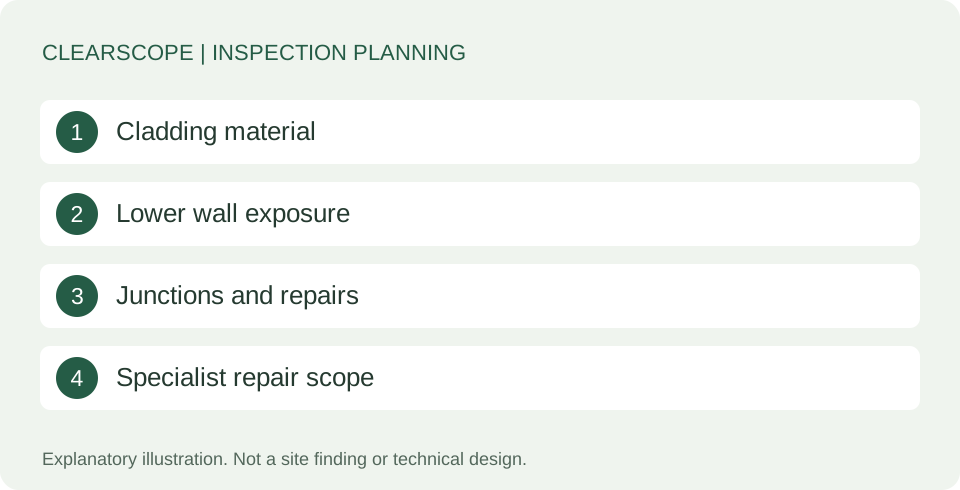
Establish what the cladding actually is
The word weatherboard describes an appearance as well as a range of products. Timber, fibre cement and other cladding systems can have similar profiles from a distance. Age, coatings and repairs may make identification uncertain. Maintenance and replacement decisions should follow the actual material and system, not the agent's shorthand description.
An inspector may be able to describe the visible profile and apparent material while qualifying identification. Laboratory identification or confirmation of a concealed product is a separate matter. If an older sheet product might contain asbestos, do not cut, sand, scrape or remove it to find out. The asbestos inspection guide explains why a general building inspection cannot give a blanket asbestos clearance.
Read paint condition in its setting
Paint helps protect some cladding materials, but it also has its own maintenance life. Fading on a sunny wall and blistering beside a repeatedly wet junction raise different questions. Record where deterioration occurs, whether it is widespread and what sits above or below it. A maintenance recommendation should be tied to that context.
Fresh paint does not establish that the substrate is sound. Nor does it prove that anyone has hidden damage. The fresh-paint guide explains a balanced approach to repairs and presentation. Ask what preparation and repairs were undertaken, and whether photographs exist of the work before repainting. These records can help direct further assessment without replacing inspection.
Pay attention to the bottom of walls
Lower boards can be exposed to splashback, damp ground and garden contact. Paving, soil or stored materials may obscure the bottom edge and the relationship between the wall and the ground. A neat garden bed can therefore limit visibility even when there is no obvious staining above it.
The inspector should record accessible conditions and significant obstructions. Exact clearance requirements depend on the building detail, material and applicable construction requirements; one number should not be applied to every older home. The buyer drainage guide helps connect wall observations with surrounding levels. Avoid digging along the wall before purchase without the owner's permission and appropriate advice.
Inspect corners and junctions together
External corners, window edges, door surrounds and roof-to-wall junctions are places where several materials meet. Visible gaps, deteriorated sealant or damaged trims may warrant attention, but the correct repair depends on the complete weatherproofing detail. Sealing every visible opening can obstruct a system that was intended to drain or move.
A visual inspection may identify an exposed concern without showing the flashing or drainage arrangement behind it. Ask what evidence would help: original details, repair photographs, a qualified trade assessment or limited opening-up with permission. Avoid assuming that a tube of sealant is either a complete solution or evidence that major reconstruction is necessary.
Distinguish board movement from structural movement
Cladding can change shape because of moisture, fixing, product movement or deterioration. Building movement can also affect junctions. One bowed board cannot establish the condition of the whole structure. The pattern matters: repeated distortion, displaced corners, cracking inside nearby rooms and changes in doors may justify a broader investigation.
The structural-movement guide concerns a different wall type, but explains the value of considering associated signs rather than a single crack. For weatherboard construction, a suitably qualified structural engineer may be needed where the visible evidence raises structural questions. A pre-purchase report does not certify the hidden frame or footing design.
Consider timber deterioration carefully
Soft-looking edges, missing material, splitting and repeated repairs may suggest deterioration. The inspector's findings should state what was observed and what could reasonably be assessed within the agreed non-invasive scope. It is not appropriate to describe every weathered board as rotten or to promise that apparently sound paint excludes decay.
If deterioration is suspected, ask whether it appears local or whether the affected area is concealed. A carpenter or building practitioner may need to assess the repair scope, while a separate timber-pest specialist may be relevant. The building and pest guide helps keep those tasks distinct. Replacement costs cannot be reliably inferred from a small visible patch alone.
Compare different elevations
A sheltered verandah wall and an exposed rear wall may have experienced very different conditions. Inspecting only the attractive front elevation gives an incomplete picture. Side passages, narrow setbacks and attached structures can also restrict how much of the cladding is visible from lawful and safe viewpoints.
Ask the report to identify which elevations were accessible and where views were limited. High walls may be observed from the ground without close access to every joint. A photograph taken from a distance can document appearance but may not reveal fine defects. If a high junction is important to the purchase, agree an appropriate specialist access method rather than expecting improvised ladder work.
Look at extensions and patch repairs
Different board profiles, altered window trims or a change in wall alignment can indicate repairs or alterations. They do not establish whether work was approved, who performed it or whether a hidden connection is adequate. Ask for the available history and compare the visible building with the supplied records.
The hidden-renovation guide explains the separation between physical observations and approval checks. Your conveyancer, council or building surveyor may need to help with records and permitted use. An inspector can flag a mismatch worth investigating without determining the legal status of an extension. Keep that unresolved question visible in your purchase decision.
Understand the limits of moisture readings
A moisture meter may help compare accessible locations where its use is appropriate. Readings depend on the material, instrument and conditions at the time. A high reading does not independently identify the source, and a low reading on a dry day does not exclude rain-driven entry at another time.
Useful findings connect readings with visible damage and the event history. Where rainwater entry is suspected, note the room, weather and timing rather than requesting indiscriminate testing. A focused special-purpose inspection may help define the next investigation step. Water testing, destructive work and laboratory analysis should be separately agreed if needed.
Turn findings into a maintenance plan
Separate the immediate concern from ordinary upkeep. A report might identify exposed deteriorated material needing trade review, a junction requiring further assessment and several elevations needing planned repainting. These are different tasks, even when they appear on the same wall. Ask contractors to quote against clearly located observations rather than a vague instruction to repair all weatherboards.
Before accepting a repair proposal, ask how the moisture source or junction detail will be addressed and whether concealed damage may change the scope. Do not assume a fixed allowance covers unseen framing. Purchase negotiations and contract protections belong with your legal adviser; the inspection supports those conversations with building information.
Arrange the right access before buying
Send ClearScope the address, photographs of the elevations that concern you and any repair or extension records. Ask the agent to make side passages and inspection access points reasonably available. You can review report examples to understand how observations and limitations may be presented, then confirm the actual scope before booking.
The aim is to understand the building you are buying, including its likely maintenance needs and important unknowns. A weatherboard exterior is neither a guarantee of easy repairs nor a warning of hidden failure. A practical inspection helps identify which questions can be answered now and which need a defined follow-up before you decide.
Ask for repair quotations with clear boundaries
Where a board repair is recommended, ask the contractor to identify the affected elevation and whether the quote covers coatings, trims and the interface with nearby windows or paving. A price for replacing visible boards may exclude hidden framing, access equipment and treatment of the moisture source. Those exclusions matter when considering your purchase budget.
The inspection report can help locate the concern, but should not be treated as a measured tender specification unless that work has been expressly commissioned. If the contractor expects to open the wall, ask how newly exposed conditions will be documented and reviewed before they are covered again. Where older materials are unidentified, resolve any hazardous-material question before disturbance. Keep the proposed repair, the supporting advice and your purchase decision connected without expecting a general inspection to guarantee the final cost.
A repair recommendation is most useful when it states both what can be seen and why further advice may change the scope. Ask for that distinction before comparing quotes, particularly where recently painted lower boards sit beside raised paving. The visible finish and the concealed repair question should remain separate in your budget.