Pre-Purchase Inspections — Fresh Paint, Patch Repairs and What They Can Hide
A freshly painted home can feel ready to move into. It can also leave a buyer wondering what the walls looked like before the sale campaign. Was the painting routine maintenance, part of a renovation, or the final step after a leak or recurring crack?
Fresh paint is not evidence of dishonesty or a building defect. The useful approach is to ask about the work, compare visible clues and understand what a visual inspection can no longer see. That gives you a better basis for deciding whether more information is needed before buying.
This guide focuses on recently covered surfaces and repair history. Our separate hidden renovation work guide considers alterations more broadly, while DIY repair guidance addresses improvised workmanship.
Ask what was done before judging the finish
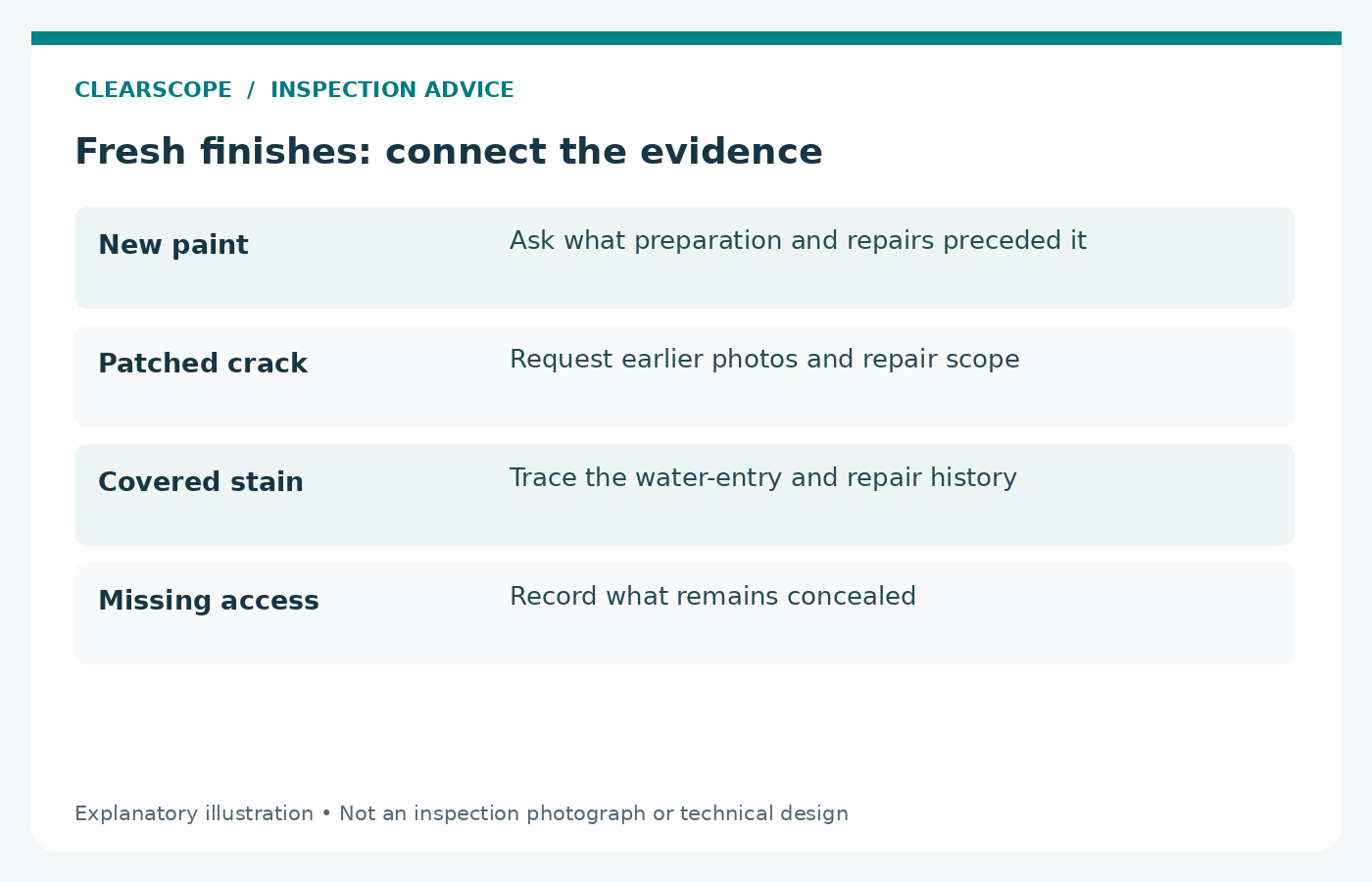
Start with simple, neutral questions. Which rooms were painted? When was the work completed? Was anything repaired first? Were the ceiling and external wall painted at the same time, or was the work limited to one patch?
A homeowner may have repainted because of wear, colour changes or preparation for sale. Equally, a patch may follow a roof leak, plumbing repair or movement. The distinction comes from the history and supporting information, not the freshness of the paint alone.
Ask the agent to obtain the seller’s written response where the issue matters to your decision. Keep it with the inspection report. The response may still need checking, but it provides a specific account to compare with invoices, photographs and the current condition.
Look for changes in texture and repair boundaries
Patches can show as a different surface texture, a ridge, a rectangular outline or uneven light reflection. Those features may indicate previous filling or replacement, but they cannot identify why the repair was needed.
A repaired opening for an old fitting is different from a long patch repeatedly appearing beside a window. Ask the inspector to identify the location and describe what is visible without turning every surface variation into a hidden structural allegation.
Normal viewing conditions matter. Strong torchlight held along a wall can exaggerate minor surface changes. The purpose of an inspection is to understand condition and relevant concerns, not to prove that no painted surface contains an imperfection.
A painted stain needs a water history
A ceiling or wall can be repainted after an old leak has been resolved. It can also be repainted while the source remains uncertain. A new finish prevents the buyer from seeing the earlier stain’s shape, extent and recurrence.
Ask where water previously appeared, under what weather conditions, what was repaired and whether there has been another rain event since. A roofing invoice should ideally identify the affected junction or roof area. “Roof maintenance” may not answer the question.
Our ceiling stain guide explains the distinction between a visible mark and its underlying source. Where a window is involved, the new recurring window water-entry guide explains how to prepare a focused investigation. Neither paint nor a single dry reading proves the entire concealed assembly is dry and sound.
Crack repairs need a timeline
Filled cracks may leave a faint line or a strip of different texture. The important questions include whether the crack returned, whether it changed and whether related symptoms appeared elsewhere.
Request any earlier photographs and the repair date. If there was engineering advice, ask for the actual document and the work it recommended. A statement that someone “looked at it” does not tell you what they assessed or what remained unresolved.
Our older-home movement guide helps buyers consider associated signs. For an owner dealing with recurrence after repairs, the special-purpose crack investigation guide explains a different pathway. A purchase inspection can recommend further advice where needed; it does not automatically include a structural diagnosis.
Check the context around the fresh surface
The wall finish is only part of the evidence. Swollen skirting, deterioration at a window reveal, changes to adjoining flooring and marks on the other side of a wall may help identify an area for closer review.
Those observations still require care. A damaged skirting board may have a different history from the painted wall beside it. The report should separate what was seen from what is suspected, then state the next useful action.
In accessible roof spaces and subfloors, other clues may remain visible even when the room has been painted. Read our inspection access guide before assuming those areas will be available. Furniture, insulation and building geometry can restrict the view.
Understand what moisture tools can and cannot establish
A moisture meter may assist an investigation when used appropriately for the material and circumstances. Its result needs context. Different substrates, metal behind a lining and surface conditions can affect interpretation.
A dry reading at one accessible point is not proof that an earlier leak was repaired or that there is no concealed damage elsewhere. Conversely, an unusual reading is not automatically proof of a particular leak source. Ask what the result indicates and what evidence would confirm the explanation.
Thermal images also need interpretation. They show temperature differences, which can have several causes. Do not assume that every inspection includes thermal imaging, water testing or opening a wall. Confirm the agreed methods and the questions they are intended to answer.
Request useful records rather than a stack of paperwork
For a repaired leak, useful records may include pre-repair photographs, the contractor’s description, the affected location and any follow-up. For a crack, ask about earlier assessments and whether the repair was decorative or involved the building structure.
If a renovation took place, request the relevant scope and available approval documents. Your conveyancer or legal adviser can explain what the documents mean for the sale. An invoice for painting is not evidence that all underlying building work was approved.
Where owner-builder work is relevant, follow the separate owner-builder report pathway. Do not assume a normal pre-purchase inspection fulfils every sale-document requirement. The documents serve different purposes and should be checked by the people responsible for them.
Keep access and permission practical
Tell ClearScope about the fresh paint or patch before the inspection. Send photographs if you have permission to take them, and explain which room or wall they show. This helps focus the visit without prejudging the outcome.
Ask the agent whether stored items can be moved from the relevant wall or access hatch before attendance. The inspector should not be expected to move heavy furniture, remove fixed finishes or damage the seller’s property to investigate a suspicion.
If opening-up is justified, it needs a separate agreed scope, the owner’s permission and appropriate arrangements for safety and reinstatement. The investigation may also need coordination with a builder, roofer, plumber or engineer depending on the concern.
Use the report to identify the unanswered question
A helpful finding might say that a recently painted patch limits assessment of previous staining, describe nearby deterioration and recommend obtaining the repair history or a scoped investigation. That is more useful than simply calling the paint suspicious.
Ask which question remains open. Is it whether the leak is active, whether damaged material remains, or whether a repaired crack is recurring? Each question may need a different method and professional.
The pre-purchase service should help you understand accessible condition and the follow-up relevant to the purchase. It cannot guarantee that the seller has disclosed every past event. Make room in your timetable to read the report and obtain further advice before making a binding decision.
An example of a balanced buying enquiry
Imagine one bedroom has a new ceiling finish while the rest of the house has older paint. The seller explains that a roof tile was damaged and supplies an invoice. The invoice identifies tile replacement, but there is no information about the affected ceiling or whether insulation was wet.
The next enquiry is not automatically a demand for a full roof replacement. It is to connect the repair location with the bedroom, clarify whether any damaged material was assessed and consider what remains visible in the roof space. If the available evidence leaves an important issue unresolved, further investigation can be discussed.
The same reasoning works in the other direction. A complete repaint with a clear maintenance history and no associated findings should not be portrayed as proof that faults were concealed. Evidence should guide the conclusion.
Common questions
Is fresh paint a red flag?
It is a reason to ask about recent work, especially where there are associated changes. It is not a diagnosis or evidence of intent. Many owners paint for entirely ordinary reasons.
Can an inspector see through a new coat of paint?
No. An inspector may identify remaining visible clues and explain limitations. No tool turns a visual inspection into a complete view of every concealed surface or past defect.
Should I ask the seller to repaint nothing else?
Raise any significant concern through the agent and your adviser before the purchase deadline. Access, preservation of evidence and further investigation need agreement. Do not alter or mark surfaces yourself.
Does a clean report prove there was never a leak?
A report describes the agreed inspection at a particular time. If past water entry is important, disclose the history and ask what additional evidence is needed. Absence of a visible stain is only one part of the picture.
Arrange a useful pre-purchase inspection
Send ClearScope the property address, inspection deadline and the location of any fresh patches or recently painted areas that concern you. Include the seller’s explanation and repair records where available. We can discuss a suitable pre-purchase inspection and flag when a separate investigation should be considered.
Ask ClearScope about recent repairs before buying.