Special-Purpose Building Reports — Investigating Recurring Water Entry Around Windows
The window has been resealed, the stain has been painted and the next storm brings the water back. It is frustrating, especially when each repair sounds straightforward but nobody has explained where the water is entering or how the proposed work will address it.
A focused building investigation starts with a clear question and the history of the problem. Water visible beside a window can relate to the window assembly, the surrounding wall, an upper junction, condensation or another source. The visible wet patch is a starting point, not a guaranteed map to the defect.
A special-purpose report needs an agreed scope. It may document accessible findings and identify further investigation, but engineering, controlled water testing, opening-up and specialist window assessment are not automatically included.
Start with the event history
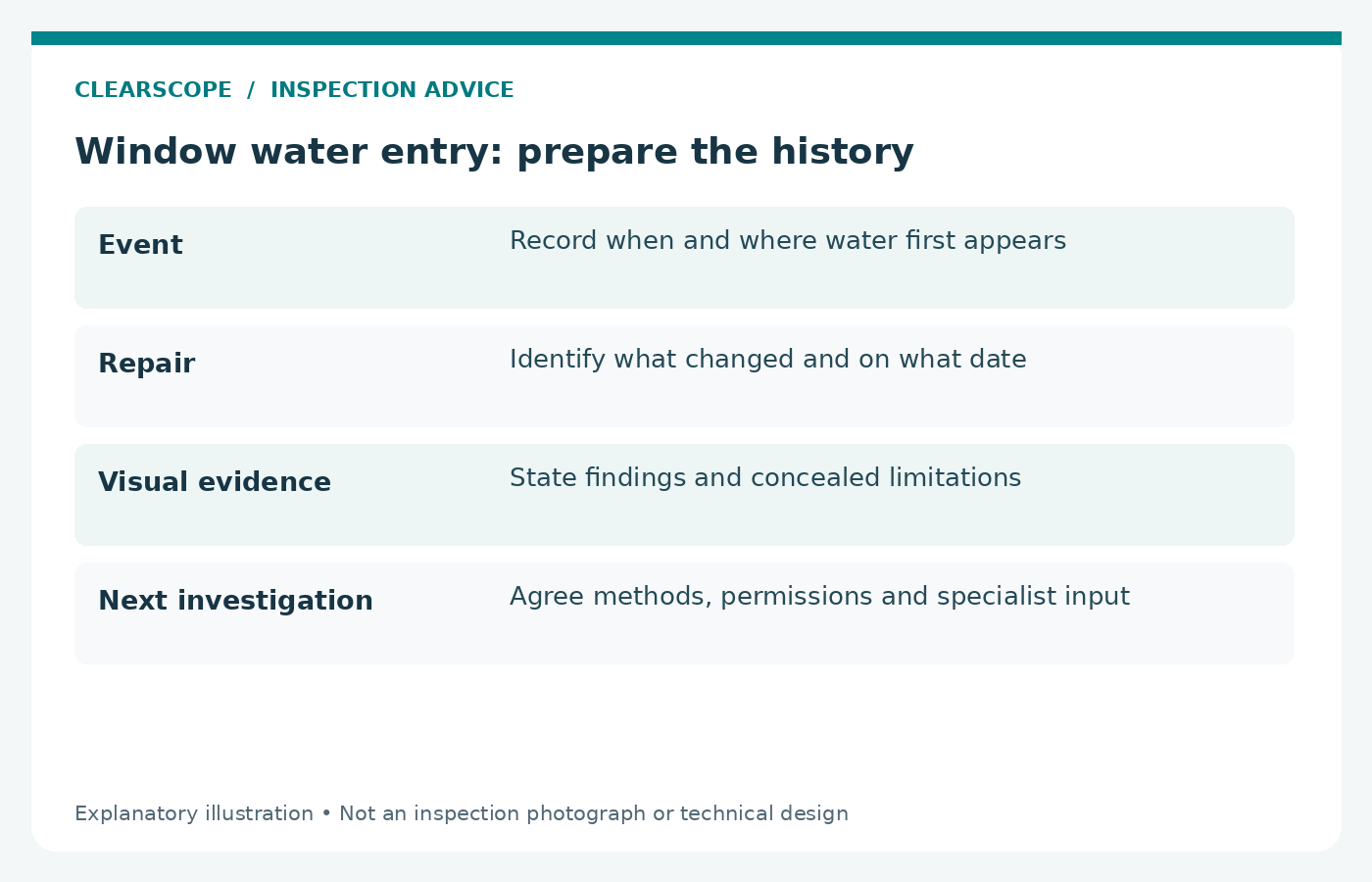
Write down when the water appears and what is happening at the time. Is it associated with wind-driven rain, prolonged rain, ordinary window operation or cold mornings? Does it affect one window or several on the same elevation?
Include the first known event, later recurrences and any changes after repairs. The history does not prove the cause, but it helps the investigator decide which questions and areas matter. “Leaks sometimes” leaves much more uncertainty than a dated description of the observed pattern.
If safe, photographs or short videos during an event can show where water first becomes visible. Include an overall room view and the window location. Do not climb outside or stand near wet electrical equipment to collect evidence.
Separate immediate protection from permanent repair
Active water entry can affect finishes, belongings and electrical safety. Arrange appropriate urgent assistance where needed, keep away from affected electrical fittings and do not wait for an inspection appointment if the situation is unsafe.
Temporary protection may reduce immediate damage, but record what was changed and by whom. A temporary cover or seal can alter the evidence available at the later inspection. Tell the provider about it rather than assuming the original condition will still be visible.
A report does not itself stop the leak. Ask who will manage any temporary measures, investigation and eventual repair. Keeping those tasks distinct helps avoid a cycle in which each person assumes another contractor has dealt with the underlying issue.
Identify which part of the junction is affected
Describe whether water appears at the head, jamb, sill, glazing line, internal reveal or adjoining wall. It may be useful to mark the first visible point on a photograph. Water can travel through concealed construction before appearing inside.
A window assembly and its wall interface are different things. The assembly includes components such as glazing, seals and drainage features. The surrounding installation involves supports, flashings, wall membranes, cladding and other junctions.
Our revised window-gap guide explains why not every opening should be filled. The existing window flashing guide addresses concealed installation details. A visible bead of sealant may cover only one part of a more complex water-management system.
Consider the wall and roof above the window
A stain beside a window does not establish that the window product is defective. The investigator may need to consider accessible wall areas, upper windows, balconies, roof-to-wall junctions and other features above or beside the affected opening.
The revised roof flashing guide explains some of those building-envelope questions. On a completed home, access and finishes can limit what can be established without additional work. A ground-level photograph cannot reveal every lap or concealed termination.
Ask whether the proposed scope considers the surrounding assembly or only the window itself. If separate contractors are involved, clarify how their findings will be coordinated. Otherwise, each may assess a narrow component while the unresolved interface remains between their scopes.
Check whether condensation is part of the picture
Moisture on glass or frames can have a different mechanism from rainwater entering through the building envelope. Condensation occurs when moist air meets a sufficiently cool surface. It can coexist with a leak, so the investigation should not choose between them without evidence.
The government’s YourHome condensation guide provides useful background. Record whether droplets appear without rain, whether the affected area dries during the day and what ventilation or heating conditions are present.
Do not assume that every wet window is an occupant-behaviour issue or that every stain means failed external flashing. A focused report should explain the observations and any remaining uncertainty. Medical advice or mould health assessment is outside an ordinary building investigation.
Give the investigator the repair history
Collect invoices, earlier reports, photographs and contractor messages. Identify where sealant was added, which components were replaced and whether the wall or internal lining was opened. Dates help connect the work to later weather events.
A repair invoice may describe the task but not the diagnosis. “Reseal window” does not establish that the contractor assessed the wall above it, tested the assembly or addressed concealed damage. Ask what investigation supported the proposed remedy.
Where the surface was repainted, earlier images become especially valuable. Our fresh paint and patch-repair guide explains why a new finish can limit visible evidence without proving anyone acted improperly. Preserve the history instead of relying on memory after several rounds of repair.
Agree the investigation question before booking
A useful brief might ask: “What accessible evidence explains recurring wetting at the upper corner of this bedroom window, and what further work is needed to confirm the source?” That is more precise than commissioning an undefined full-house report.
Discuss the property, affected openings, available records, access and intended use of the report. If it will be supplied to a builder, insurer or another party, explain that purpose. The provider should confirm whether the scope and format suit the task.
Use the service overview and contact ClearScope to arrange a scoped enquiry. Do not assume a standard pre-purchase, PCI or maintenance inspection includes a complete leak investigation or a guaranteed source diagnosis.
Understand the limits of a visual visit
Accessible observations may include staining, material deterioration, visible sealant condition and the relationship between the opening and surrounding construction. Those observations can support recommendations, but concealed flashings or internal window drainage may remain unseen.
A moisture meter or thermal camera may assist where appropriate and included. Readings and images need interpretation; they do not prove the cause in isolation. Ask what was measured, under what conditions and what the result can reasonably establish.
A dry inspection day can still produce useful information, but may not reproduce the event. The report should explain whether the evidence supports a likely pathway, identifies a defect or leaves a question requiring further testing. Those are different levels of certainty.
Plan any testing or opening-up separately
Controlled water testing needs an appropriate method, permissions and people who can interpret the result. An improvised hose test can introduce water in an unrealistic way, damage the building or obscure the original problem. Do not begin one without agreement and suitable expertise.
Opening a lining or removing part of a window also needs a defined scope. Confirm who performs the work, manages hazards, records the exposed condition and reinstates it. In an older building, suspect hazardous materials may require assessment before disturbance.
The Australian Glass and Window Association guide series provides industry context for window installation. The actual manufacturer and wall-system instructions remain important. A general detail should not be used to prescribe a repair for an unidentified assembly.
Ask for a repair proposal tied to the evidence
A useful proposal explains the observed problem, the intended repair and the parts of the assembly being addressed. It should also identify assumptions and any further findings that could change the scope once work is opened.
Ask how the work will be checked afterwards. A neat internal repaint does not demonstrate that the water path has been resolved. Conversely, waiting for every possible weather condition may be impractical, so the verification approach should be realistic and clearly documented.
The rectification reinspection guide explains how to define the next review. State whether it concerns exposed repair work, completed surface condition, document review or separately arranged testing. Do not label all of those activities as the same inspection.
Keep building findings separate from responsibility
A focused report may identify defects or recommend further investigation. It does not automatically determine warranty coverage, insurance acceptance, contractual liability or who must pay. Those questions depend on the documents and circumstances.
For a new home, raise the issue with the builder in writing and keep the response. For a purchased older home or shared building, other parties may need to be involved. Seek the appropriate advice rather than assume one pathway applies to every property.
Our builder-response guide helps organise item-specific questions. If the matter is disputed, tell the report provider before booking so the intended purpose and any further professional requirements can be considered.
A focused follow-up example
Imagine a window has been sealed twice along its lower external edge, but water is first seen at the upper internal corner during wind-driven rain. The useful next step is to review the event history and surrounding construction, not simply add another bead in the same place.
A scoped visit may identify accessible defects, relevant limitations and whether further window-specialist testing or opening-up is justified. The report should distinguish those findings from unverified possibilities and explain what evidence the next step is intended to obtain.
That gives the owner a practical investigation sequence rather than another unqualified promise that resealing will solve every leak.
Common questions
Can you guarantee the source will be found in one visit?
No. Intermittent water entry and concealed construction can require staged investigation. The agreed scope should explain what the visit can assess and when further work may be needed.
Is resealing always the answer?
No. The appropriate repair depends on the assembly and evidence. Some openings are intentional drainage features, and indiscriminate sealing can interfere with them.
Will the report include engineering or invasive work?
Only through a separately agreed appropriate scope. Do not assume those services are part of a standard focused visual inspection.
Discuss the recurring problem with ClearScope
Send the address, affected window locations, event photographs and previous repair details. We can discuss a special-purpose scope prepared and authorised by a suitably qualified ClearScope Building Practitioner, including any access limits and specialist follow-up.