Pre-Purchase Inspections — Roof Leaks, Ceiling Stains and Evidence of Previous Repairs
A ceiling stain in a home you want to buy raises an obvious question: is the roof still leaking? A freshly repaired roof raises another: what was repaired, and how was the outcome checked? Neither an old stain nor a neat invoice answers both questions on its own.
Start with the location, the repair history and the accessible condition now. A pre-purchase inspection can bring visible clues together and identify where further roofing or plumbing assessment is needed. It cannot guarantee that an intermittent leak will appear during the appointment or certify every concealed roof junction.
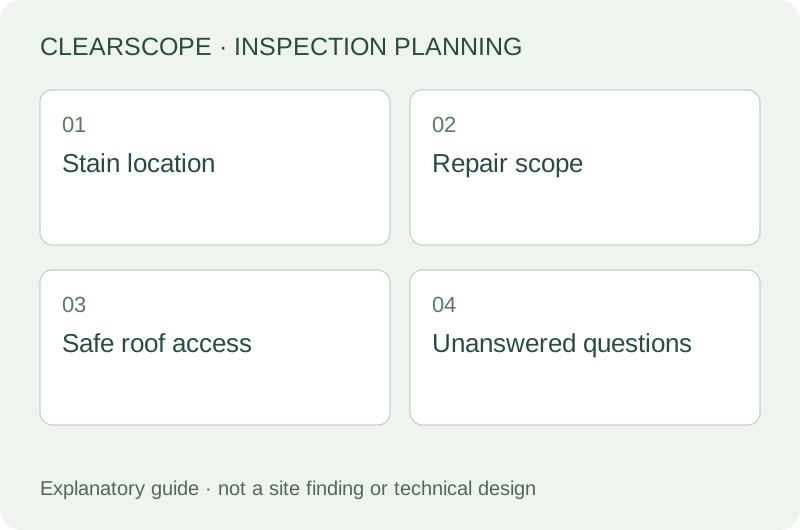
Establish what the stain actually tells you
Record the room and the position of the mark in relation to external walls, bathrooms, roof changes and service penetrations. Is the surface discoloured, swollen, cracked or recently patched? Are there several marks or one local area? Describing the observation gives a more useful starting point than calling every stain a failed roof.
Water can travel before it appears on a ceiling. The entry point may not be directly above the visible mark, and moisture can have sources other than the roof. Plumbing, condensation and an upper-level wet area may also deserve consideration. An inspector should distinguish observed damage from an unconfirmed explanation.
For a visibly distorted ceiling, the sagging-ceiling buyer guide covers the separate question of ceiling condition. Keep people away from visibly unstable or bulging material and arrange appropriate help promptly. A routine purchase inspection should not be used to delay a safety response.
Ask what happened before the repair
Ask the seller or agent when the leak was first noticed, where water appeared and what weather conditions were involved. Was it associated with wind-driven rain, overflowing drainage or a particular roof junction? Was the ceiling repaired at the same time, or later? Ask for dates where available and mark uncertain recollections as uncertain.
Request the available report, quotation, invoice and photographs. They may show whether a contractor investigated the source, carried out a temporary measure or completed a defined repair. A document headed roof repairs may contain only a narrow task. Read its scope before treating it as evidence that the whole roof was assessed.
The seller's account is useful background, but remains supplied history unless independently supported. ClearScope should not present that account as a direct site observation. A clear report separates what was said, what documents were supplied and what could actually be seen at the inspection.
Read the repair scope beside the symptom
A receipt for replacing several tiles answers a different question from a report about a flashing junction. Gutter cleaning, sealant application and replacement of damaged roof components also have different purposes. Ask why that work was selected and whether the contractor recorded any remaining concerns or exclusions.
Do not assume a warranty means the underlying cause has been proven or that every future leak is covered. Obtain advice about the actual document and its terms. ClearScope does not determine contractual enforceability or whether a warranty transfers to a purchaser; your conveyancer or the issuing contractor can address those questions.
Keep the roof and the ceiling as related but separate repair scopes. A ceiling may remain stained after the water source is corrected. Conversely, replacing the ceiling does not establish that the source has been addressed. Before budgeting for decoration, establish what further investigation is required.
Understand the value of safe roof-space access
Where safe and accessible, a roof-space view may provide context such as visible staining, deteriorated materials or evidence of previous work. Access can be restricted by low clearance, insulation, stored items, services, roof construction or safety conditions. The report should describe the actual limitation.
Read our roof-space and subfloor access guide before assuming that an access hatch allows inspection of the whole roof. An inspector does not remove ceilings, insulation or roof coverings simply because a purchaser wants certainty. Permission, safety and the agreed scope still apply.
If an important junction cannot be assessed, ask what targeted specialist access or investigation would help. A qualified roofer or roof plumber may be needed. A second appointment with the same access limitation may provide little additional information unless the scope or conditions change.
Connect roof drainage to the visible evidence
Gutters, downpipes, valleys and discharge arrangements can contribute to water-entry questions. A visible blockage or defect may justify follow-up, but a clear gutter at one moment does not prove performance during heavy rain. Buried drainage is another separate system with its own access and testing requirements.
Use the drainage guide for buyers to distinguish surface observations from pipe performance. The flat and low-pitched roof guide covers roof-form issues; this article focuses on reconciling leak symptoms with repair evidence before purchase.
BPC moisture and ventilation guidance discusses keeping water-management components maintained. General maintenance guidance does not diagnose a particular roof. Your inspection findings and the relevant contractor's assessment should determine the next step for the property.
A dry inspection day still has limits
A dry appointment can record visible evidence of earlier water entry and inspect accessible details. It cannot reproduce every combination of rainfall, wind direction, blockage and occupancy. Absence of visible moisture on that day is useful information within that limit; it is not a roof leak guarantee.
If moisture readings form part of the agreed assessment, they need interpretation in context. Material, instrument, location and conditions affect their meaning. A reading alone does not identify the source, prove that all concealed materials are dry or establish that an intermittent leak has been permanently repaired.
Ask whether observations after recent weather would materially help. Our post-storm buyer guide concerns a change since an earlier inspection. A return visit should have a defined purpose, such as reviewing a reported new stain, rather than simply repeating an appointment in the hope that certainty improves.
Treat fresh finishes as a visibility issue
Fresh paint and patching may be ordinary sale preparation. They can also reduce the visibility of earlier marks. Ask about the history without assuming concealment or dishonesty. A clean ceiling, by itself, cannot establish the condition of the roof above it.
Our fresh paint and patch-repair guide addresses the broader question of recently finished surfaces. Here, the useful task is linking a specific roof repair to a specific reported leak. Look for dates, locations, work descriptions and an explanation of how the result was checked.
Photographs can help if they show identifiable areas and their source is known. Retain original files where possible. A close-up without a room or roof location may be difficult to interpret, and an undated image should not quietly be treated as evidence of current condition.
Turn uncertainty into a purchase question
List what remains unresolved: the source of the stain, the extent of affected materials, the adequacy of the repair evidence or the need for specialist access. Ask which question is important enough to resolve before committing and which person is best placed to answer it.
If a repair quotation is needed, ask whether it includes investigation, access, removal and reinstatement of finishes, and checking the repaired area. A figure for repainting the ceiling should not be used as a budget for an uninvestigated roof leak. Conversely, a stain alone does not justify assuming a complete roof replacement.
Consumer Affairs Victoria explains the role of independent inspection before purchase. Your conveyancer should advise on access, contract conditions and deadlines. A building report does not itself extend a deadline or establish a right to cancel.
Questions buyers commonly ask
Can an old stain remain after a successful repair? Yes, affected finishes may still show it. Can a roof leak recur despite a recent invoice? The invoice describes work, not every future condition. Should a stain automatically stop a purchase? The useful response is to understand the evidence and obtain the necessary advice before deciding.
Can ClearScope certify the roof is watertight? A visual pre-purchase inspection does not provide that guarantee. If testing or specialist certification is needed, agree the separate scope and appropriate provider. Controlled water testing also requires permission and a suitable method; it should not be improvised by a prospective buyer.
Make the location traceable
Where several roof repairs are documented, ask which room or roof section each invoice concerns. A receipt for the garage does not explain a bedroom stain unless the relationship is established. Use a simple room-and-roof sketch for orientation, labelled as your note rather than an approved drawing. If the contractor cannot identify the earlier work precisely, retain that uncertainty. It may mean that current inspection and a targeted roofing assessment carry more weight than a general statement that the roof was repaired. Clear location information helps each professional address the same concern.
Bring the repair history to the inspection
Send ClearScope the property address, purchase deadline, location of the concern and available repair documents. Include what the seller has said, while keeping that separate from your own observations. We can discuss the accessible inspection scope and whether a targeted specialist should also attend.
Ask about a pre-purchase inspection or review our report examples. The benefit is a clearer decision: what the visible evidence supports, what the repair records explain and which important roof questions still need an answer.