Special Purpose Mould Inspections — Mould Returning After Cleaning: Moisture, Ventilation and the Next Steps
You have cleaned a mould patch, but it keeps returning. Perhaps it is on a bedroom wall, a bathroom ceiling or behind furniture. The repeated cleaning can be frustrating because it changes the surface without explaining why the area keeps becoming damp.
The useful next step is to investigate the building conditions associated with the moisture. ClearScope can discuss a special purpose inspection of the agreed areas, including moisture readings and ventilation observations where suitable to the scope. Tell us where the growth returns and when you notice it so we can explain what the assessment can establish before you book.
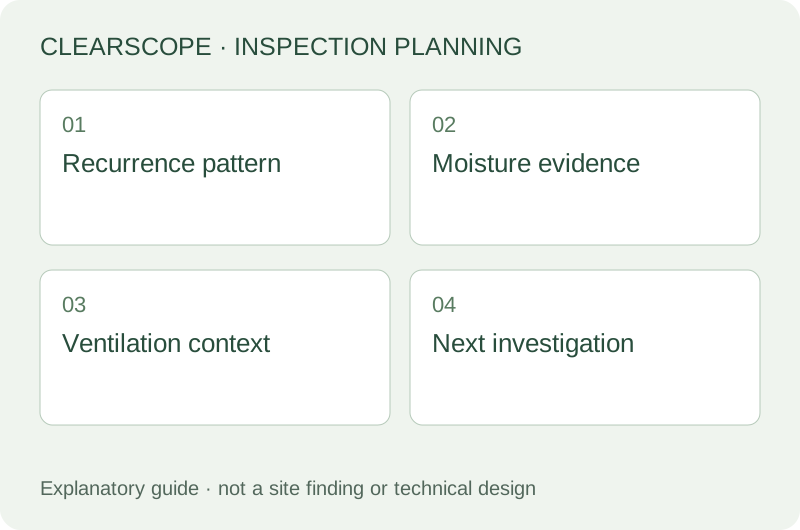
Begin with the recurring pattern
Note the exact location, the surface and the timing. Does the patch return after rain, after shower use, during cold weather or after the room has been closed? Is it at an external corner, around a window, near a plumbing fixture or on the ceiling below another room?
These patterns help organise the investigation; they do not prove a cause on their own. Condensation, water entry, plumbing leakage and retained moisture can produce overlapping evidence. Several influences may occur together. A practical inspection should bring the clues together without diagnosing the building from the colour of a patch.
Take safe photographs before and after cleaning if they already exist, and retain their dates. Do not leave a condition untreated merely to create evidence. Explain any recent paint, new furniture, repairs or changed room use because they may affect what can be observed at the appointment.
Separate cleaning from moisture control
Cleaning may remove visible material from a surface, but it does not necessarily correct the conditions supporting its return. A leak can continue behind a cleaned wall. Condensation can recur at a cool surface. A previously wet material may also need further assessment even if its face looks improved.
The BPC condensation and mould guidance describes interactions between moisture, ventilation and the building. It supports investigating the conditions rather than treating every recurrence as the same cleaning problem.
ClearScope does not prescribe a universal cleaning chemical or remediation method from a photograph. The appropriate response depends on the material, extent, moisture source and any specialist requirements. Health concerns belong with a healthcare professional; a building inspection is not a medical assessment.
Consider condensation without blaming occupants
Condensation occurs when water vapour collects on a sufficiently cool surface under the conditions present. Indoor humidity, heating, ventilation, insulation and the building envelope can all influence it. Daily activities may contribute moisture, but that does not establish that an occupant caused the problem.
A useful assessment looks at the room and building context. Are windows regularly wet? Is airflow restricted behind furniture? Is an exhaust system present, and what can be observed about its operation or discharge arrangement? What parts of the envelope are visible, and what information remains unavailable?
The BPC moisture and ventilation guidance provides general context about moisture and ventilation. A recommendation for a particular home still needs to address its actual circumstances. Opening a window should not be offered as a complete answer to an uninvestigated leak or building defect.
Keep rainwater entry and plumbing in the picture
If the concern follows rainfall, consider accessible roof, wall, window and drainage evidence. If it relates to fixture use, a plumbing or wet-area investigation may be needed. A mark below a bathroom may also have more than one possible source, so its position alone should not settle the diagnosis.
Our window water-entry guide covers recurring leaks at an opening. The roof leak and repair guide explains useful repair-history questions. These resources can help you prepare information without assuming those are the sources in your home.
Where visible drainage or subfloor moisture is relevant, the drainage guide and underfloor moisture guide explain access and evidence limits. A room inspection should not quietly be described as a full assessment of inaccessible roof or underfloor construction.
Understand the agreed inspection scope
A special purpose appointment should name the concern and the areas being assessed. For example, the scope may focus on a bathroom and adjoining bedroom, with relevant accessible building observations. Confirm what is included before assuming that every room, roof junction or concealed cavity will be investigated.
Where moisture readings are undertaken, they should be linked to locations and interpreted with the material and conditions. Readings help inform the assessment but do not independently identify a fungal species, measure exposure or prove the full extent of hidden damage.
Ventilation observations also need a clear boundary. Noting a fan or accessible duct arrangement is different from specialist airflow measurement, system commissioning or opening concealed ducts. If a more detailed assessment is needed, the report should identify that next step rather than imply it has already occurred.
Know what the inspection does not establish
A non-invasive building inspection cannot certify that a property is mould-free. It does not identify every concealed affected surface, and the appearance of a patch cannot determine its species or health significance. ClearScope does not imply laboratory sampling, air testing or medical assessment is included.
The Victorian Government mould and health guidance provides public information about mould and health. Use qualified health advice for symptoms or individual vulnerability, rather than asking a building report to declare a room medically safe.
Invasive investigation, laboratory assessment and remediation verification are separate scopes where required. Permission, method and appropriate expertise need agreement. A report should explain what was accessible, what was observed and what remains uncertain without turning a limitation into either reassurance or alarm.
Prepare a short moisture history
List when you first noticed the concern, where it returns and what was done. Include cleaning, repainting, plumbing work, roof repairs and changes to fans or heating. Keep invoices and earlier photographs where available. If a date is approximate, say so.
Also explain whether the property was vacant, whether the room's use changed and whether a significant water event occurred. These details may help interpret the evidence. They should remain clearly identified as supplied history unless verified by records or observation.
Avoid changing everything just before the inspection merely to make the room look normal. At the same time, do not recreate unsafe conditions or deliberately wet materials. Ask ClearScope what preparation is useful for the agreed assessment and provide honest information about conditions at the time.
Turn the report into a practical sequence
The first task is to identify what the evidence supports about the moisture conditions. The next may be a targeted trade assessment, a building-envelope investigation or clarification of a concealed detail. Cleaning and reinstatement can then be planned around the cause and affected materials rather than treated as the entire solution.
Ask which recommendations need action first and why. A report should distinguish observed damage, plausible contributing factors and issues requiring further confirmation. It should not promise that one change will permanently stop recurrence where the evidence is incomplete.
If you need a detailed works plan, budget advice or sequencing beyond the findings report, discuss that scope separately before commissioning it. ClearScope does not imply that a basic inspection includes quotations, project coordination or specialist remediation design. The written agreement should make the deliverable clear.
Check the repair outcome using suitable evidence
Ask the responsible contractor what their work addresses and how its completion will be documented. A cleaned wall is evidence of surface treatment, not proof that a hidden leak has stopped. Conversely, a residual stain may remain after a source is corrected, so appearance alone may not settle the result.
Where a return inspection is appropriate, agree its purpose. It might review accessible completed work or compare specified observations. It is not automatically a laboratory clearance or a guarantee against future growth. Conditions, access and any remaining uncertainty should be stated.
Our report examples can show the reporting style. Any example is illustrative of format, with its own scope; it should not be read as a promise that every test or finding shown will be part of your appointment.
Questions people ask about recurring mould
Does recurrence prove a hidden leak? No; it is a reason to investigate the conditions, with several possible influences. Does a dark colour mean a particular dangerous species? Colour alone cannot establish species or health significance. Does a dry reading rule out a moisture problem? Not necessarily; location, material, timing and intermittent conditions matter.
Should a dehumidifier or new fan be the first purchase? It may have a role in a suitable plan, but establish the important building question before assuming equipment will resolve it. A ventilation change cannot repair an unrelated plumbing leak. Recommendations should follow the evidence and the actual system.
Arrange an inspection focused on your concern
Send the address, affected rooms, recurrence pattern, relevant photographs and repair history. Tell ClearScope about access restrictions and the decision you need to make. We can discuss the inspection areas, included observations, report deliverable and any separate specialist work.
Ask about a special purpose mould inspection or explore ClearScope services. The aim is clarity about the moisture problem and a useful next step, so you are not left repeating the same surface treatment without understanding why the concern returns.