Roof Space Damp on Dry Mornings: Condensation or a Roof Leak?
You find fresh dampness below a metal roof after a night with no obvious rain. By lunchtime the mark looks much the same as yesterday and the drip has stopped. Do you ask someone to look for a hole in the roof, or investigate moisture collecting underneath the sheets? The useful starting point is a record of when the wetness appears, where it is first seen and what else was happening at the property. The ceiling mark is part of that record. The place where the water became visible and the place where it started may be separated by several roof components.
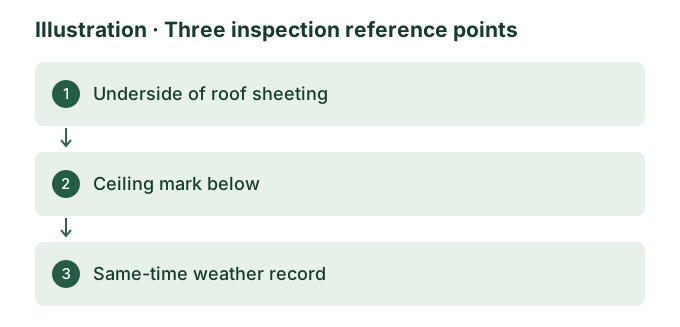
A focused building inspection can help you decide who needs to look next and what they should investigate. The inspection is normally organised around accessible areas and conditions on the day. It is worth knowing beforehand whether your concern is an intermittent drip, damp insulation reported by another trade, a discoloured ceiling or visible spotting on a lining. Each gives the inspector a different place to start. Include any photos the roofer or electrician already took and ask them which roof bay the pictures show.
Work out what was actually wet
Take a wide photo of the room from the doorway if it is safe to do so. Follow it with a closer photo of the affected area and note the first time you saw fresh moisture. For a patch in an older ceiling, describe whether the surface felt wet before, whether a drip was seen or whether it is an old mark whose colour looks different under morning light. On repeat visits to the same room, photograph from the same position so a change in camera angle does not look like a change in the boundary of the stain.
Ask anyone who has safely observed the roof space to distinguish between droplets on the underside of the roof, staining on timber, visible wet insulation and moisture on the upper face of the ceiling. They are separate observations. A roof with more than one type of construction can also have a tight section over an extension and a more accessible cavity over the original house. Photos from the larger cavity tell you little about the tight section. Our guide to roof-space inspection access explains how a hatch, obstructions and limited clearance affect coverage. The access principles also matter when investigating a home you already own.
Compare mornings with rain events
Start with a short chronology. Record the last known rain, whether it was windy, when the heating or exhaust equipment was running and when the affected room was last seen dry. Save the earlier photos alongside the later ones. A nearby weather record can give useful context, but rain at a weather station can differ from conditions at your home. A note that someone saw rain hitting the side of the extension helps locate the exposure. If you were away, leave the observation period open rather than assuming the roof stayed dry the whole time.
Moist air can deposit water when it encounters a sufficiently cold surface. The ABCB handbook explains why the underside of metal cladding may cool overnight and why roof assemblies can incorporate a layer that manages droplets. A pattern of droplets across multiple exposed sheets on a dry morning is a reason to investigate condensation. Localised wetting near a penetration after wind-driven rain raises a different question about a water entry path. Either pattern needs to be interpreted with the roof layout and access limits. Water can move along a sheet, support or underlay before it reaches the ceiling.
If your main evidence is an old discoloured patch that appeared after known rain, our guide to ceiling stains and repair history explains why dated repair records are worth finding. For an occupied home, add a record of what changed after the repair. Ask whether the tradesperson photographed the work and whether anybody checked the original patch during another period of similar rain. A successful repair to one entry point can sit alongside a separate moisture issue in the same roof.
Ask where moist air and water could travel
Where safely visible, the inspector may compare the area around the stain with an unaffected area, check accessible roof-space surfaces and describe what is visible around the nearest ceiling or roof penetration. A bathroom or laundry exhaust route is worth locating on a plan. A fan that runs tells you that the fan switches on. A visible duct at one end tells you where part of the route goes. It can still take a suitable trade to establish how the duct terminates and whether the system performs as intended. Ask whether there are installation photos, a fan model or documents showing which outlet belongs to that room.
Roof profile, a nearby valley, penetrations and transitions between old and new roof sections are worth recording. Our guide to low-pitched roofs provides context for the junctions and access limits an inspector may note. A section with no safe access may need a separate assessment by a roofing practitioner. If other symptoms include dampness near a room unit, the air-conditioning damp investigation guide sets out questions about that specific symptom. Try to keep the positions separate on a simple room sketch so evidence from one location does not get attributed to another.
Use comparable observations to choose a next step
Here is an illustrative example. A household notices droplets on the kitchen ceiling on two clear mornings in a week. A roofer has a photo from safe access showing scattered droplets under several sheets above the room, but a wall stain near the extension also darkened after a recent storm. Put each symptom on the drawing with its date. Ask the roofer to record where the wall stain sits relative to the roof junction, and ask the building inspector whether the underside pattern can be seen across accessible roof bays. It may be sensible to scope the two areas separately, even if the first visit assesses both.
If the building inspector uses a moisture instrument on accessible finishes, ask what was compared and how the readings are recorded. A relative indication at the damp patch and an indication in a comparable unaffected part of the same material can guide further enquiry. Different layers, embedded metal and varying conditions affect interpretation. A reading beside an old patch is one observation at that time. If the symptom only occurs before sunrise and access is available in the afternoon, the report should make the difference between the reported timing and the actual observations clear.
The report can also help you plan what evidence to seek before authorising work. A roof plumbing assessment may focus on the external junction identified from the wet-weather sequence. A ventilation or building-envelope assessment may focus on an accessible assembly where there is evidence of widespread underside moisture. Ask each practitioner what must be observed or tested to confirm their scope. This is particularly helpful if proposals range from resealing an isolated penetration to changing several parts of the roof. The proposed work should be tied to a documented condition or a clearly identified question.
Protect access and keep the evidence useful
Keep occupants away from visibly unstable or bulging ceiling areas and arrange prompt professional help where there is active water around electrical fittings. Use safe positions in rooms to record observations and leave roof access and electrical investigation to appropriately equipped practitioners. If part of the inspection needs access by a specialist or permission to open a lining, ask what needs to be visible, who will arrange it and how findings will be recorded before reinstatement. The condition can change quickly once heat, ventilation or weather changes.
Where spotting or musty odour persists, explain that to the inspector and state where it was detected. Our guide to mould that returns after cleaning discusses tracking changes without treating the appearance of a patch as proof of its cause. The Better Health Channel advises seeking medical advice if you are concerned about mould exposure. A building inspection addresses the building conditions, visible damage and potential moisture paths in the agreed scope. Any health assessment belongs with an appropriate health professional.
If you already have a quote, highlight which areas it covers and which areas it assumes are dry. Compare the quote to the room and roof sketch. Ask what the practitioner will check before doing the work and how you can tell afterwards whether the original symptom has changed. Where a repair is urgent, keep any pre-repair photographs that can be taken safely and ask for a short written account of what was exposed. Include the location and date alongside any details of removed wet material so the repair history remains usable.
Decide whether a return visit would help
If a dry-weather visit establishes the accessible layout but finds no fresh dampness, discuss whether a second visit during the reported conditions would change the decision. A return after overnight cooling may help compare the affected roof surfaces with the first set of observations. If the only issue left is a roof junction that becomes wet during a particular wind direction, it may be more useful to organise the roofing assessment first. Ask what the next visit is expected to resolve and whether any intervention between visits would make the records hard to compare. Save the dates of any changes.
Brief the inspector on the unresolved decision
Send the room and roof layout if you have it, the times the moisture appeared and any notes from earlier roof or exhaust work. Identify areas you can safely make available and any owners corporation or other permission you need to arrange. Tell us whether the next decision is whom to engage, what to include in a repair scope or how to check a previously treated area. The clearer the question, the easier it is to agree which areas and conditions the inspection can cover.
Our inspection report examples show how location, observed conditions and follow-up can be set out. For recurring roof-space moisture, useful findings should let the next practitioner identify the affected bay or area, understand what was actually seen and know where access was limited. Retain that report with your photos and repair correspondence. If moisture reappears, the next observation can then be compared with an existing record rather than relying on memory of where a ceiling mark started.