Special Purpose Inspections — Damp Chimney Breasts After Rain: What Should Be Investigated?
A damp patch around a chimney breast can raise several questions at once. Water may be entering near a roof junction, travelling through masonry or appearing on a cool internal surface. The mark inside the room is where moisture becomes visible, which may be some distance from its entry point. Before another coat of paint or a local sealant repair, establish what should actually be investigated.
ClearScope can discuss a special-purpose inspection focused on the existing moisture concern and accessible surrounding building details. This is not a chimney-safety, flue-operation or combustion assessment. Roof access, controlled water testing, opening-up and specialist trade work require their own safe and agreed arrangements where needed.
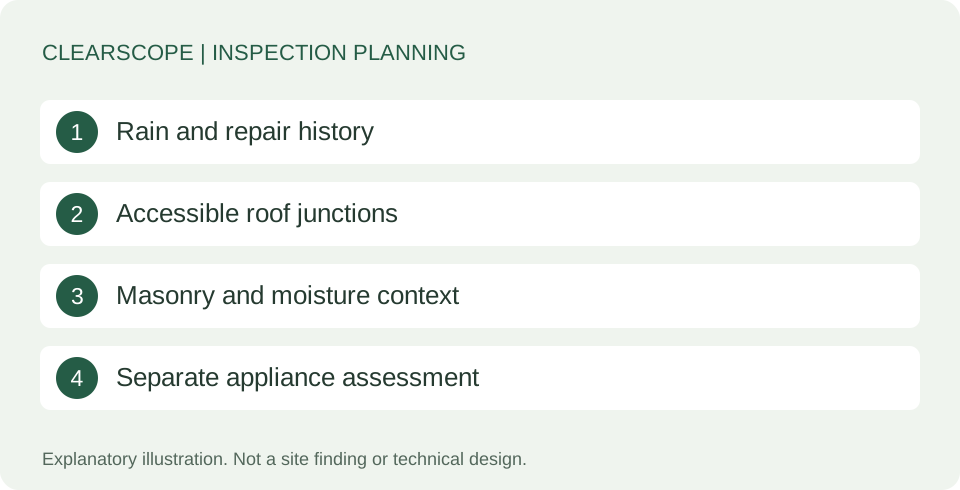
Describe the affected surface precisely
A stain on the ceiling beside a chimney, damp plaster on the breast and moisture within a fireplace opening are different observations. Note the room, height, material and approximate extent. Include whether the surface is damp to the touch, visibly discoloured or damaged, without treating touch alone as a reliable measurement.
Photographs should show an overview and the detail when safe to obtain. Avoid climbing onto the roof or reaching into an unsafe fireplace to document the issue. If there is an immediate safety concern, seek appropriate assistance before continuing to use the area. A building inspection can be arranged once suitable access and the investigation purpose are clear.
Build a rain and use history
Record when the mark appears and whether it follows rain, wind from a particular direction or use of the heating appliance. A long delay after rain may be relevant, but timing alone cannot establish the route through the building. Some materials retain moisture and may dry slowly after the weather changes.
Tell the inspector whether the fireplace is used, sealed, altered or disconnected, if known. Do not operate it to reproduce a symptom without appropriate specialist advice. The chimney and fireplace purchase guide concerns buyer due diligence; this investigation needs a focused history of the existing dampness and any previous repair attempts.
Consider the roof junction as a system
Where a chimney passes through a roof, several junctions and materials interact. Accessible visible concerns may include damaged coverings, deteriorated junctions or previous patch repairs. The inspector may observe some details from safe locations, but cannot assume that a ground-level view reveals the complete flashing arrangement.
The roof-leak history guide explains why a stain and a repair invoice need context. A roofing specialist may need to assess details beyond the available visual scope. Avoid describing a particular flashing as failed unless the evidence supports it, and do not assume a visible sealant patch is the only possible pathway.
Look above and around the internal mark
Moisture can travel along surfaces or through connected materials before appearing inside. The visible mark may therefore warrant inspection of surrounding roof areas, ceiling spaces and masonry rather than only the precise point above the stain. Safe access and the construction determine what can be assessed.
The access-limitations guide explains why an available hatch does not guarantee access to every roof zone. In a special-purpose investigation, exclusions should be connected to the unanswered question. If the relevant side of a chimney is inaccessible, the report should make clear that its condition has not been confirmed rather than treating a partial view as complete.
Treat masonry appearance as evidence to interpret
Cracking, deteriorated mortar, staining or deposits on accessible masonry can be relevant observations. Their meaning depends on the location, material, exposure and history. White deposits, for example, do not independently establish a structural problem or identify the current water entry route. A detailed trade assessment may be required to determine suitable repairs.
The efflorescence guide explains visible salt deposits in a purchase setting. For a chimney dampness concern, keep the investigation question specific: what accessible conditions may contribute, what evidence is missing and which specialist should review it? An inspector should not certify concealed brickwork, flue lining or structural capacity from external appearance.
Keep condensation among the possibilities
A cool surface and moist indoor air can contribute to condensation under suitable conditions. An unused or altered fireplace may also need specialist consideration of ventilation and its intended arrangement. These possibilities should be assessed alongside rainwater entry and other moisture sources, rather than used as a convenient explanation for every damp patch.
BPC moisture guidance provides general context, not a diagnosis of this property. A focused mould enquiry may be relevant if nearby finishes also show growth, but the chimney investigation should remain tied to the actual building evidence. Health questions and mould identification are separate from the visual moisture assessment.
Ask what previous repairs changed
Obtain available invoices, photographs and descriptions of earlier roofing, masonry or internal repair work. A statement that the chimney was fixed may mean repointing, sealing a junction, capping an opening or simply repairing the interior finish. Each addresses a different part of the problem and leaves different questions.
The recurring-crack guide illustrates why repair history should identify the actual work, not just a completion date. For dampness, ask whether the area was monitored after repair and under what conditions. Do not infer negligence or concealment because a symptom returned. The useful next step is to assess whether the earlier repair addressed the pathway now suspected.
Understand moisture-tool limitations
Where included and appropriate, moisture readings may help compare accessible surfaces. Material composition, salts, instrument type and measurement conditions affect interpretation. The result should be considered with visible damage and the history, not used alone to identify a roof leak or declare that masonry is dry throughout.
Thermal images, if separately available and agreed, also need interpretation and do not show through walls. A report should explain which tools were used and what they support. If the surface was recently heated, cleaned or repainted, tell the inspector. A reading on the day is a snapshot, and a dry result cannot guarantee that the symptom will not recur in different weather.
Plan any further testing deliberately
Controlled water testing or opening-up may be useful when it answers a defined unresolved question, but neither should be improvised by the owner. Testing can introduce water or damage finishes, and access may involve work at height. Agree permissions, the method, the relevant specialist and how the results will be interpreted before proceeding.
The window water-entry guide describes the same principle for a different junction. A targeted test should follow the evidence rather than saturate several areas at once and make the source harder to distinguish. A visual building report should not imply that such testing was performed if the visit only involved observations and accessible measurements.
Separate building repair from appliance safety
A dry-looking chimney is not proof that a fireplace or flue is safe to operate. Likewise, an appliance service does not necessarily establish the weatherproofing condition of the roof junction. Ask appropriately qualified specialists about combustion, gas, electrical or flue concerns according to the system actually installed.
If the chimney is to be removed, reduced or altered, obtain the necessary structural, design and permit advice before work. Do not assume it is a simple maintenance task because the interior fireplace is unused. The inspection can help identify building questions and visible concerns, while the relevant professionals determine the safe and lawful scope of alteration or repair.
Agree a repair and follow-up question
A useful next step links the proposed repair to the observed condition and remaining uncertainty. Ask the contractor what will be changed, what will remain concealed and how the result will be reviewed. Internal decoration should be considered with drying and source resolution, rather than used as the only measure of success.
Send ClearScope the address, photographs, event history and previous repair information. Review report examples and confirm the accessible scope before booking. The aim is a practical account of what the evidence supports and which further assessment may help, without promising a definitive cause, full concealed-condition assessment or appliance safety certification from one visual visit.
Identify whether the chimney is shared or altered
Where the chimney adjoins another dwelling, has been partly removed or sits within a later extension, tell the inspector before the visit. These conditions may affect access, interpretation and which professionals need to be involved. A visible chimney breast does not establish that the stack above is original, continuous or independently supported.
Ask for any available alteration drawings and relevant completion records. If neighbouring property access would help, it must be arranged through an appropriate lawful process rather than assumed. The inspection can record the accessible side and explain the resulting limits. Structural changes, shared ownership and approval questions require the relevant engineering, surveyor or legal advice. Keeping those matters separate from the moisture symptom prevents a local dampness enquiry being mistaken for a full assessment of the chimney's structure, ownership or operating safety.
Ask the report to name the relevant next professional where possible: a roofing trade for an inaccessible roof junction, a plumber for a service concern or an engineer for structural questions. That is more useful than an unexplained recommendation to investigate further, while still leaving specialist findings to the person undertaking that work.